Assam TET Academy Mobile Application

CTET Dec 2018 Maths, Paper 1
Find the official answer key for CTET December 2018 Mathematics Paper 1. Download detailed solutions, analysis, and key highlights to help you prepare for the exam. Stay updated with the most accurate resources for your CTET preparation!
| FaceBook Page | Join Now |
| WhatsApp Channel | Join Now |
| Telegram Channel | Join Now |
CTET Mathematics : Paper 1
Prepare effectively for the CTET Mathematics Paper 1 with our comprehensive Study Materials, Mock Tests and Previous Year Questions. Our resource provides an extensive collection of practice papers designed to simulate the actual exam environment, helping you gain confidence and improve your problem-solving skills. Each mock test is crafted to cover a wide range of topics and question formats that are typically seen in the CTET Mathematics Paper 1, ensuring you are well-prepared for any type of question that may appear.
- Total Questions: 30
- Total Marks: 30
- Type of Questions: Multiple Choice Questions (MCQs)
- Duration: Part of the overall 150-minute exam for Paper 1
| Number System | Click Here |
| Addition and Subtraction | Click Here |
| Division | Click Here |
| Face Value and Place Value | Click Here |
| LCM and HCF | Click Here |
| Average | Click Here |
| Percentage | Click Here |
| Profit and Loss | Click Here |
| Speed, Distance and Time | Click Here |
| Money | Click Here |
| Measurement of Time | Click Here |
| Area and Volume | Click Here |
| Geometry and Shapes | Click Here |
| Data Handling | Click Here |
CTET December 2018 : Mathematics, Paper 1
PART - I / भाग - I
Mathematics / गणित
Direction : Answer the following questions (Q. Nos 31 to 60) by selecting the correct/most appropriate options.
निर्देश : निम्नलिखित प्रश्नों (प्रश्न संख्या 31 से 60) के उत्तर सही/सबसे उपयुक्त विकल्पों का चयन करके दीजिए।
31. The assessment of what children learn in mathematics in primary classes should not focus on (प्राथमिक कक्षाओं में बच्चे गणित में क्या सीखते हैं, इसके आकलन का ध्यान किस पर नहीं होना चाहिए)
(1) Understanding of the mathematical concepts (गणितीय अवधारणाओं को समझना)
(2) Development of mathematical language (गणितीय भाषा का विकास)
(3) Preciseness in answering mathematics problems (गणित की समस्याओं का जवाब देने में सटीकता)
(4) Development of reasoning skills (तर्क कौशल का विकास)
32. What sequence of the following instructions should be followed in development of a mathematical concept in elementary classes (प्रारम्भिक कक्षाओं में एक गणितीय अवधारणा के विकास में निम्नलिखित निर्देशों का अनुक्रम किस प्रकार किया जाना चाहिए)
I. Drawing pictures (चित्र बनाना)
II. Using symbolic representation (प्रतीकात्मक प्रतिनिधित्व का उपयोग करना)
III. Providing experiences (अनुभव प्रदान करना)
IV. Explaining through language (भाषा के माध्यम से समझाना)
(1) IV, III, I, II
(2) III, IV, I, II
(3) IV, III, II, I
(4) III, I, II, IV
33. A child subtracted two numbers as shown below : (एक बच्चे ने नीचे दिखाए अनुसार दो संख्याएँ घटाई)
83
– 27
64
Which one of the following statements gives idea about the child’s learning of subtraction (निम्नलिखित में से कौन-सा कथन बच्चे के घटाव सीखने का बोध कराता है)
(1) The child has misconceptions about place value in the process of subtraction (बच्चे को घटाव की प्रक्रिया में स्थानीय मान के बारे में गलत धारणाएँ हैं)
(2) The child does not know how to subtract (बच्चा नहीं जानता कि कैसे घटाना है)
(3) The child knows the process of subtraction of two-digit numbers (बच्चा दो अंकों वाली संख्याओं के घटाव की प्रक्रिया जानता है)
(4) It is a mistake and it can be rectified by repeated practice (यह एक गलती है और इसे बार-बार अभ्यास करके सुधार किया जा सकता है)
34. Arrange the following steps of cycle of learning and assessment in order : (अधिगम और आकलन के चक्र के निम्नलिखित चरणों को क्रम में व्यवस्थित कीजिए)
I. Teaching-learning integrated with assessment (शिक्षण अधिगम के साथ एकीकृत आकलन)
II. Planning and organization of teaching-learning and assessment (शिक्षण-अधिगम और आकलन की योजना बनाना और उसका संगठन)
III. Developing progress reports (प्रगति रिपोर्ट का विकास)
IV. Reporting and communicating feedback of children’s learning and progress (बच्चों के अधिगम और प्रगति की प्रतिपुष्टि की रिपोर्टिंग और उसका संचार)
(1) II, I, III, IV
(2) I, II, IV, III
(3) IV, I, II, III
(4) II, IV, I, III
35. Why are Roman numerals not commonly used in writing numbers like the Hindu-Arabic numerals (रोमन अंकों का उपयोग आमतौर पर हिंदू-अरबी अंकों जैसी संख्याओं के लेखन में क्यों नहीं किया जाता)
(1) The Roman numerals do not employ place value, so calculations are difficult to perform using these numerals (रोमन अंक स्थानीय मान का नियोजन नहीं करते हैं, इसलिए इन अंकों का उपयोग करके गणना करना मुश्किल होता है)
(2) Roman numerals are difficult to remember (रोमन अंकों को याद करना मुश्किल है)
(3) The formation of numbers using Roman numerals is a complicated task (रोमन अंकों का उपयोग करके संख्याओं को बनाना एक जटिल कार्य है)
(4) Children get confused with the English alphabet and Roman numerals (बच्चे अंग्रेजी वर्णमाला और रोमन अंकों में भ्रमित हो जाते हैं)
CTET Previous Year Question Papers for Mathematics
Explore comprehensive solutions and answer keys for CTET Mathematics, Paper 1 from previous years. Our collection includes detailed question papers, solutions, and expert analysis to help you prepare effectively for the Central Teacher Eligibility Test. Access valuable resources and enhance your exam strategy with real exam questions and solutions.
| CTET June 2011, Paper - 1 | Click Here |
| CTET Jan 2012, Paper - 1 | Click Here |
| CTET Nov 2012, Paper - 1 | Click Here |
| CTET July 2013, Paper - 1 | Click Here |
| CTET Feb 2014, Paper - 1 | Click Here |
| CTET Sep 2014, Paper - 1 | Click Here |
| CTET Feb 2015, Paper - 1 | Click Here |
| CTET Sep 2015, Paper - 1 | Click Here |
| CTET Jan 2016, Paper - 1 | Click Here |
| CTET Feb 2016, Paper - 1 | Click Here |
| CTET Sep 2016, Paper - 1 | Click Here |
| CTET Dec 2018, Paper - 1 | Click Here |
| CTET Dec 2019, Paper - 1 | Click Here |
| CTET July 2019, Paper - 1 | Click Here |
| CTET Jan 2021, Paper - 1 | Click Here |
| CTET Dec 2022, Paper - 1 | Click Here |
| CTET Jan 2022, Paper - 1 | Click Here |
| CTET Aug 2023, Paper - 1 | Click Here |
| CTET Jan 2023, Paper - 1 | Click Here |
| CTET Jan 2024, Paper - 1 | Click Here |
| CTET July 2024, Paper - 1 | Click Here |
| CTET Dec 2024, Paper - 1 | Click Here |
36. A teacher encourages the children in her class to explain the physical properties of the objects around them in their own words. What is the most appropriate objective of the teacher to do such an activity with her students (एक शिक्षक अपनी कक्षा में बच्चों को उनके परिवेश में मौजूद वस्तुओं के भौतिक गुणों को अपने शब्दों में समझाने के लिए प्रोत्साहित करता है | अपने छात्रों के साथ ऐसी गतिविधि करने के पीछे शिक्षक का सबसे उचित उद्देश्य क्या है)
(1) It is a very interesting activity which can be performed in the free time for revisiting the concept of shapes (यह एक बहुत ही रोचक गतिविधि है जिसे आकार की अवधारणा को पुनः देखने के लिए खाली समय में किया जा सकता है)
(2) Children enjoy explaining the objects in their own language like they enjoy playing dumb charades (बच्चे अपनी भाषा में वस्तुओं को समझाने का आनंद लेते हैं जैसे कि वे डंब शराड्स खेलने का आनंद लेते हैं)
(3) It makes the children observe the physical properties of an object informally which deepens their understanding about shapes (यह बच्चों को अनौपचारिक रूप से किसी वस्तु के भौतिक गुणों का निरीक्षण करने का अवसर देता है जो आकारों के बारे में उनकी समझ को गहन बनाता है)
(4) It is a useful activity which introduces a child to the shapes (यह एक उपयोगी गतिविधि है जो एक बच्चे को आकारों का परिचय कराती है)
37. The mathematics used by illiterate shopkeeper (अशिक्षित दुकानदार द्वारा उपयोग किए जाने वाले गणित)
(1) Is not useful in the mathematics classroom (गणित कक्षा में उपयोगी नहीं हैं)
(2) Is very useful in solving all mathematical problems (सभी गणितीय समस्याओं को हल करने में बहुत उपयोगी हैं)
(3) Has ambiguity and very low level of correctness in it (में अस्पष्टता और बहुत कम स्तर की शुद्धता है)
(4) Should be discussed by the teachers in classrooms as an alternate strategy in solving related problems (की संबंधित समस्याओं को हल करने में वैकल्पिक रणनीति के रूप में कक्षाओं में शिक्षकों द्वारा चर्चा की जानी चाहिए)
38. How should a teacher handle a heterogeneous group of children in a mathematics classroom (एक शिक्षक को गणित कक्षा में बच्चों के एक विषम समूह को कैसे संभालना चाहिए)
(1) By grouping the children of same ability together and giving them questions according to their ability (एक ही क्षमता वाले बच्चों को एक साथ समूहित रखकर और उनकी क्षमता के अनुसार प्रश्न देकर)
(2) By grouping all children together in the same classroom (एक ही कक्षा में सभी बच्चों को एक साथ समूहित रखकर)
(3) By grouping the children of different abilities together so that they can learn from each other (अलग-अलग क्षमताओं वाले बच्चों को एक साथ समूहित रखकर ताकि वे एक-दूसरे से सीख सकें)
(4) By doing questions according to low ability children in the class and giving the complex questions as home assignments to higher ability children (कम क्षमता वाले बच्चों के अनुसार कक्षा में प्रश्न हल करके और उच्च क्षमता वाले बच्चों को जटिल प्रश्न गृहकार्य के रूप में देकर)
39. The learning outcomes in mathematics are developed (गणित में सीखने के प्रतिफल इसलिए विकसित किए गए है ताकि)
(1) Such that children may be told small steps for calculations (गणना के लिए बच्चों को लघु विधियाँ बताई जाए)
(2) To increase the achievement of children in various educational surveys (विभिन्न शैक्षणिक सर्वेक्षणों में बच्चों की उपलब्धि बढ़ाई जाए)
(3) To define class wise competencies and skills to be achieved by children (बच्चों द्वारा हासिल की जाने वाली कक्षावार दक्षता और कौशल को परिभाषित किया जाए)
(4) To prepare children for year-end examinations (वर्ष की अंत परीक्षाओं के लिए बच्चों को तैयार किया जाए)
Mathematics : Chapter, Paper 1
| Mathematics Topics | Click Here |
| Pedagogy of Mathematics | Click Here |
| Mathematics MCQ Question | Click Here |
| Previous Year Question | Click Here |
40. Which one of the following happenings in the classroom is an activity (निम्नलिखित में से कक्षा में हो रहा कौन-सा कार्य एक गतिविधि है)
(1) Teacher explaining how to do sums (शिक्षक समझाते हैं कि प्रश्न कैसे हल करें)
(2) Children reciting counting in form of rhymes (बच्चों द्वारा कविता के रूप में गिनती का वाचन)
(3) Children copying from blackboard (बच्चों द्वारा श्यामपट्ट से नकल करना)
(4) Children engaged in exploration (बच्चों का अन्वेषण में लगना)
41. To develop skill of counting among children, which one of the following is not required to be learned as pre-number concept (बच्चों के बीच गिनती के कौशल को विकसित करने के लिए निम्नलिखित में से कौन-सा, पूर्व-संख्या अवधारणा के रूप में सीखने के लिए आवश्यक नहीं है)
(1) One to one correspondence (एक-एक संगतता)
(2) Seriation (क्रमबद्धता)
(3) Reciting number names randomly (संख्या नाम यादृच्छिक रूप से पढ़ना)
(4) Creating groups (समूह बनाना)
42. On asking a child ‘‘What is area’’, he/she answered length × breadth. What can you say about the child’s understanding about the concept of area (एक बच्चे से यह पूछने पर कि "क्षेत्रफल क्या है?", उसने लंबाई चौड़ाई उत्तर दिया। क्षेत्रफल की अवधारणा के बारे में बच्चे की समझ के बारे में आप क्या कह सकते हैं)
(1) The child has no idea about the concept of area (बच्चे को क्षेत्रफल की अवधारणा के बारे में कोई जानकारी नहीं है)
(2) The child used the area of rectangle as general idea of area of any closed shape (बच्चे ने किसी भी बंद आकार के क्षेत्रफल के सामान्य विचार को आयत के क्षेत्रफल के रूप में उपयोग किया)
(3) The child is right in saying area is length × breadth (बच्चा सही कह रहा है कि क्षेत्रफल लंबाई × चौड़ाई है)
(4) The child is confused between the concept of area and perimeter (बच्चा क्षेत्रफल और परिमाप की अवधारणा के बीच उलझन में है)
43. Which one of the following statements is true with respect to mathematics learning (गणित सीखने के संबंध में निम्नलिखित में से कौन-सा कथन सत्य है)
(1) Mathematics is a difficult subject to learn (गणित सीखने के लिए एक कठिन विषय है)
(2) Generally girls are weaker in mathematics (आमतौर पर लड़कियाँ गणित में कमजोर होती हैं)
(3) Everybody can learn mathematics (हर कोई गणित सीख सकता है)
(4) Mathematics can only be learnt by rigorous practice (गणित केवल कठोर अभ्यास से सीखा जा सकता है)
44. To teach the Pythagoras theorem, a teacher has distributed a sheet on which four right-angled triangles were drawn and asks the child to find the relationship between the sides of a triangle. In the above situation, the teacher used (पायथागोरस प्रमेय को सिखाने के लिए एक शिक्षक ने एक शीट वितरित की है जिस पर समकोण वाले चार त्रिभुजों को खींचा गया था और बच्चे को त्रिभुज की भुजाओं के बीच संबंध खोजने के लिए कहा जाता है | उपर्युक्त परिस्थिति में शिक्षक ने प्रयोग किया)
(1) Inductive method (आगमन विधि)
(2) Deductive method (निगमन विधि)
(3) Lecture method (व्याख्यान विधि)
(4) Laboratory method (प्रयोगशाला विधि)
YouTube Channel
| Assam TET Academy | Subscribe Now |
| Career Niyog | Subscribe Now |
45. Which one of the following statements is not true about ‘concept maps’ (निम्नलिखित में से कौन-सा कथन 'संकल्पना मानचित्र' के बारे में सत्य नहीं है)
(1) Concept maps represent a collection of interconnected concepts and links connecting them (संकल्पना मानचित्र अन्तःसंबंधित अवधारणाओं और उन्हें जोड़ने वाले लिंक का संग्रह प्रस्तुत करते हैं)
(2) Concept maps should be constructed by teachers only (संकल्पना मानचित्र केवल शिक्षकों द्वारा बनाया जाना चाहिए)
(3) Concept maps are hierarchical in nature (संकल्पना मानचित्र प्रकृति में पदानुक्रमित हैं)
(4) Concept maps help in linking prior knowledge to new instruction (संकल्पना मानचित्र नए शिक्षण को पूर्व ज्ञान से जोड़ने में सहायक हैं)
46. 2/3 + 4/5 is
(1) 6/8
(2) 1-6/15
(3) 1-7/15
(4) 8/15
47. For the given shapes, which one of the following statements is not correct (दिए गए आकारों के लिए निम्नलिखित में से कौन-सा कथन ठीक नहीं है)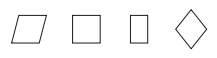
(1) All are parallelograms (सभी समांतर चतुर्भुज हैं)
(2) One of them is not a parallelogram (इनमें से एक समांतर चतुर्भुज नहीं है)
(3) Two of them are rhombuses (इनमें से दो समचतुर्भुज हैं)
(4) Two of them are rectangles (इनमें से दो आयत है)
48. Which one of the following represents the number ‘eleven thousand eleven hundred eleven’ (निम्नलिखित में से कौन-सा 'ग्यारह हजार ग्यारह सौ ग्यारह' संख्या का प्रतिनिधित्व करता है)
(1) 111111
(2) 12111
(3) 11000110011
(4) XIXIXI
Previous Year Question Papers For CTET, Paper I
Explore comprehensive solutions and answer keys for CTET Mathematics, Paper 1 from previous years. Our collection includes detailed question papers, solutions, and expert analysis to help you prepare effectively for the Central Teacher Eligibility Test. Access valuable resources and enhance your exam strategy with real exam questions and solutions.
| CDP | Click Here |
| Mathematics | Click Here |
| EVS | Click Here |
| English | Click Here |
| Hindi | Click Here |
| Assamese | Click Here |
| Bengali | Click Here |
49. The points A and B represent numbers on a number line as shown below :
The distance between the points A and B is
(1) 29000 units
(2) 84000 units
(3) 22 units
(4) 22000 units
50. How many packets of 1/16 kg sugar can be made from 31/4 kg of sugar
(1) 52
(2) 48
(3) 12
(4) 64
51. Harish started his journey at 18:40 and finished at 22:20. The time taken in completing the journey is
(1) 3 hours 40 minutes
(2) 3 hours 80 minutes
(3) 4 hours 40 minutes
(4) 3 hours 20 minutes
52. A bucket of capacity 2000 mL is to be filled by using containers measuring 200 mL and 300 mL. Which one of the following combinations of containers is not correct for filling the bucket completely by the containers of 200 mL and 300 mL respectively
(1) 1, 6
(2) 4, 4
(3) 7, 2
(4) 6, 3
Previous Year Question Papers For CTET, Paper II
Explore comprehensive solutions and answer keys for CTET Paper 2 from previous years. Our collection includes detailed question papers, solutions, and expert analysis to help you prepare effectively for the Central Teacher Eligibility Test. Access valuable resources and enhance your exam strategy with real exam questions and solutions.
| CDP | Click Here |
| Maths & Science | Click Here |
| Social Stuies | Click Here |
| English | Click Here |
| Hindi | Click Here |
| Assamese | Click Here |
| Bengali | Click Here |
54. If one small square in the grid is of area 4 sq. units, what is the perimeter of the rectangle drawn on the grid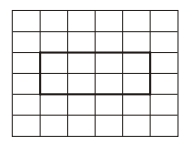
(1) 32 units
(2) 8 units
(3) 24 units
(4) 12 units
55. A child scored 75 marks in each of five subjects. What is the median marks obtained by the child
(1) 75
(2) 375
(3) 15
(4) 70
57. If Red part in the following pie chart is 40, what is White part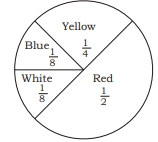
(1) 5
(2) 10
(3) 12
(4) 20
59. Which one of the following costs more
I. 200 packets of R250 each
II. 20 dozens of R250 each item
(1) I
(2) II
(3) Both I and II are equal
(4) Cannot be calculated
60. The sum of 1 - 1 + 1 - 1 + 1 - 1 ...... to even number of terms is—
(1) Zero
(2) 1
(3) 1
(4) 2

Study Materials (AssamTET.com)
| Assam TET-LP | Assam TET-UP | CTET - Paper 1 |
| CTET - Paper 2 | ADRE Grade 3 | ADRE Grade 4 |
| Assam Police | D.El.Ed | Class - 10 |
| Asaam TET-GT | Assam TET-PGT | Class - 12 |
Recent Posts
- Assam D.El.Ed. Admission 2026 – SCERT PET for 2 Year Diploma Course
- Assam PNRD Recruitment 2026 – 1508 Vacancies for AE, GRS, Computer Assistant & More | Apply Online
- RRB NTPC Recruitment 2025 – Apply Online for 8850 Graduate & Under Graduate Level Posts
- 2005 voter list download assam
- Assam DElEd Admission 2025 : Online Apply
- Dibrugarh University B.Ed Admission 2025 – DU B.Ed CET Online Form
- SSUHS BPharm & DPharm Admission 2025 – Apply Online
- AIIMS BSc & MSc Nursing Entrance Exam 2025 - Apply Now!
- SSUHS BSc Nursing Admission 2025 – Apply Online
- SAMARTH 2025 : One-Stop Online Portal for Assam College Admissions
- CTET Dec 2018 Paper 2 Question With Answer
- CTET July 2019 Paper 2 Question With Answer
- CTET Dec 2019 Paper 2 Question With Answer
- CTET Dec 2022 Paper 2 Question With Answer
- CTET Aug 2023 Paper 2 Question With Answer
Important Links
- Anundoram Borooah Award 2024 – ARBAS Online Application
- PRC Certificate Assam : How to Online Apply Permanent Residence certificate
- APDCL Recruitment 2024 |Apply Online for 69 Assistant Accounts Officer
- SCERT Assam D.El.Ed Admission 2024 : Online Application Form
- SAMARTH Admission Portal 2024 - Online Apply BA, B.Com and B.Sc Courses
- SSUHS B.Pharm And D.Pharm Admission 2024 – Online Apply
- KKHSOU 2nd Semester UG Courses - Apply Online for 2024 Admission
- KKHSOU 2nd Semester PG Courses - Apply Online for 2024 Admission
- Assam Direct Recruitment Syllabus 2024 – Grade 3 Exam Pattern with pdf
- NEET 2024 Syllabus PDF by NTA