Assam TET Academy Mobile Application

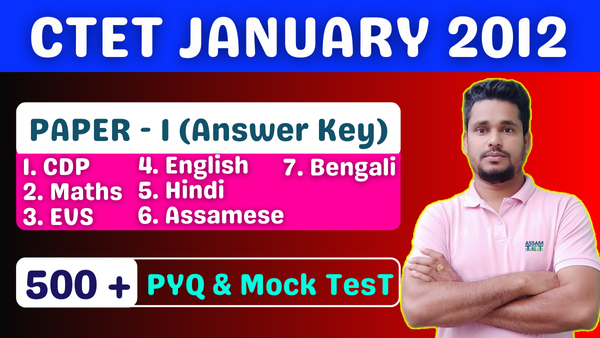
CTET Jan 2012 Paper 1 Question With Answer
Access CTET January 2012 Paper 1 Question with Answer Key PDF. Get comprehensive solutions, expert explanations, and accurate answers to enhance your CTET exam preparation. Download now!
Access CTET January 2012 Paper 1 Question with Answer Key PDF. Find detailed solutions, expert explanations, and accurate answers to enhance your CTET exam preparation effectively.
💠 Child Development and Pedagogy
💠 Mathematics / गणित
💠 Environment Studies
💠 Language - I : English
💠 भाषा - I : हिंदी
💠 Language - II : English
💠 भाषा - II : हिंदी
💠 Language - I : Assamese
💠 Language - I : Bengali
💠 Language - II : Assamese
💠 Language - II : Bengali
PART - I / भाग - I
Child Development and Pedagogy / बाल विकास और शिक्षणशास्त्र
Direction : Answer the following questions (Q. Nos 1 to 30) by selecting the correct/most appropriate options.
निर्देश : निम्नलिखित प्रश्नों (प्रश्न संख्या 1 से 30) के उत्तर सही/सबसे उपयुक्त विकल्पों का चयन करके दीजिए।
1. A teacher, after preparing a question paper, checks whether the questions test specific testing objectives. He is concerned primarily about the question paper’s
A. Validity
B. Content coverage
C. Typology of questions
D. Reliability
2. Critical pedagogy firmly believes that
A. The teacher should always lead the classroom instruction
B. The learners ned not reason independently
C. What children learn out of school is irrelevant
D. The experiences and perceptions of learners are important
3. Scholz-based assessment is primarily based on the principle that
A. Assessment should be very economical
B. Teachers know their learners’ capabilities better than external examiners
C. Students should at al costs get high grades
D. Schools are more efficient than external bodies of examination
4. Learners display individual differences. So a teacher should
A. Insist on uniform pace of learning
B. Provide a variety of learning experiences
C. Enforce strict discipline
D. Increase number of tests
5. Vygotsky emphasised the significance of the role played by which of the following factors in the learning of children?
A. Social
B. Hereditary
C. Moral
D. Physical
6. A teacher makes use of a variety of tasks to cater to the different learning styles of her learners. She is influenced by
A. Piaget’s cognitive development theory
B. Kohlberg’s moral development theory
C. Gardner’s multiple intelligence theory
D. Vygotsky’s socio-cultural theory
7. A teacher never gives answers to questions herself. She encourages her students to suggest answers, have group discussions and adopt collaborative learning. This approach is based on the principle of
A. Active participation
B. Proper organisation of instructional material
C. Seting a god example and being a role-model
D. Readiness to learn
8. Which of the following is a teacher-related factor affecting learning?
A. Mastery over the subject-mater
B. Proper seating arrangement
C. Availability of teaching-learning resources
D. Nature of the content or learning experiences
9. A school gives preference to girls while preparing students for a State level solo-songs completion. This reflects
A. Gender bias
B. Global trends
C. Pragmatic approach
D. Progressive thinking
10. The most effective method to teach the concept of germination of seeds is
A. To give detailed explanations
B. To make the students plant seeds and observe stages of germination
C. To draw pictures on the black-board and give descriptions
D. To show pictures of sed growth
11. When a child ‘fails’, it means
A. The child is not fit for studies
B. The child has not memorised the answers properly
C. The child should have taken private tuition
D. The system has failed
12. The emphasis from teaching to learning can be shifted by
A. Focusing on examination results
B. Adopting child-centerer pedagogy
C. Encouraging rote learning
D. Adopting frontal teaching
13. Inclusive Education
A. Includes teachers from marginalised groups
B. Celebrates diversity in the classroom
C. Encourages strict admission procedures
D. Includes indoctrination of facts
14. Which of the following is an objective question?
A. Essay type question
B. Short answer question
C. Open ended question
D. True or False
15. Which of the following is a feature of progressive education?
A. Flexible time-table and seating
B. Instruction based solely on prescribed text books
C. Emphasis on scoring god marks in examinations
D. Frequent tests and examinations
16. According to Piaget’s stages of Cognitive Development, the sensory-motor stage is associated with
A. Concerns about social issues
B. Imitation, memory and mental representation
C. Ability to solve problems in logical fashion
D. Ability to interpret and analyse options
17. According to Kohlberg, a teacher can install moral values in children by
A. Giving strict instructions on ‘how to behave’
B. Giving importance to religious teachings
C. Laying clear rules of behaviour
D. Involving them in discussions on moral issues
18. Young learners should be encouraged to interact with pers in the classroom so that
A. The teacher can control the classroom better
B. They can learn answers to questions from each other
C. The syllabus can be covered quickly
D. They learn social skills in the course of study
19. When a child with a disability first comes to school, the teacher should
A. Conduct an admission test
B. Refer the child to a special school according to the disability
C. Seclude him from other students
D. Discus with the child’s parents to evolve collaborative plans
20. Errors of learners often indicate
A. Socio-economic status of the learners
B. How they learn
C. The need for mechanical drill
D. Absence of learning
21. Which of the following is the first step in the scientific method of problem-solving?
A. Formation of hypothesis
B. Verification of hypothesis
C. Problem awareness
D. Collection of relevant information
22. Human personality is the result of
A. Only heredity
B. Upbringing and education
C. Interaction between heredity and environment
D. Only environment
23. Individual attention is important in the teaching—learning process because
A. Children develop at different rates and learn differently
B. Learners always learn biter in groups
C. Teacher training programmed prescribe it
D. It offers better opportunities to teachers to discipline each learner
24. Which of the following is a domain of learning?
A. Professional
B. Experiential
C. Affective
D. Spiritual
25. When a child gets bored while doing a task, it is a sign that
A. The child needs to be disciplined
B. The task may have become mechanically respective
C. The child is not intelligent
D. The child is not capable of learning
26. In the context of education, socialisation means
A. Always following social norms
B. Creating one’s own social norms
C. Respecting elders in society
D. Adapting and adjusting to social environment
27. Which of the following is a principle of development?
A. Al processes of development are not interconnected
B. It does not proceed at the same pace for all
C. Development is always linear
D. It is a discontinuous process
28. Human development is divided into domains such as
A. Physical, spiritual, cognitive and social
B. Physical, cognitive, emotional and social
C. Emotional, cognitive, spiritual and social psychological
D. Psychological, cognitive, emotional and physical
29. A teacher uses a text and some pictures of fruits and vegetables and holds a discussion with her students. The students link the details with their previous knowledge and learn the concept of nutrition. This approach is based on
A. Construction of knowledge
B. Classical conditioning of learning
C. Theory of reinforcement
D. Operant conditioning of learning
30. A child starts to cry when his grandmother takes him from his mother’s lap. The child cries due to
A. Separation anxiety
B. Social anxiety
C. Emotional anxiety
D. Stranger anxiety
PART - I / भाग - I
Mathematics / गणित
Direction : Answer the following questions (Q. Nos 31 to 60) by selecting the correct/most appropriate options.
निर्देश : निम्नलिखित प्रश्नों (प्रश्न संख्या 31 से 60) के उत्तर सही/सबसे उपयुक्त विकल्पों का चयन करके दीजिए।
32. Use of Abacus in Class I does not help the students to
A. Understand the significance of place value
B. Read the numbers without error
C. Write the numeral equivalent of numbers given in words
D. Attain perfection in counting
33. In which of the following divisions, will the remainder be more than the remainder you get when you divide 176 by 3?
A. 174 ÷ 4
B. 175 ÷ 3
C. 176 ÷ 2
D. 173 ÷ 5
34. 50 cm + 50 m + 5 km =
A. 50 m
B. 55 m
C. 505 m
D. 5 m
35. Sum of place values of 6 in 63606
A. 60606
B. 606
C. 606
D. 18
36. The difference of 5671 and the number obtained on reversing its digits is
A. 4906
B. 3916
C. 7436
D. 3906
37. Study the following pattern:
1 × 1 = 1
1 × 1 = 121
11 × 11 = 12321
.... ....
What is 111 × 111?
A. 123454321
B. 12345421
C. 123453421
D. 1234321
38. ‘Recognition of patterns and their completion’ is an essential part of Mathematics curriculum at primary stage as it
A. Develops creativity and artistic attributes in students
B. Prepares students to take up competitive examinations
C. Helps the students in solving ‘Sudoku’ puzzles
D. Promotes creativity amongst students and helps them to understand properties of numbers and operations
39. Which of the following is correct?
A. Predecessor of successor of 100 is 100
B. Predecessor of predecessor of 100 is 99
C. Successor of predecessor of 100 is 101
D. Successor of predecessor of 100 is 102
40. A shop has 239 toys. Seventy more toys were brought in. Then 152 of them were sold. The number of toys left was
A. 239 + 70 + 152
B. 239 – 70 + 152
C. 239 + 70 – 152
D. 239 – 70 – 152
41. A pencil costs two and a half rupees. Amit buys one and a half dozen pencils and gives a 10 rupee note to the shopkeeper. The money he will get back is
A. Rs. 45
B. Rs. 65
C. Rs. 30
D. Rs. 5
42. In the product 3759 × 9573, the sum of tens' digit and units' digit is
A. 7
B. 9
C. 16
D. 0
43. What time is 4 hours 59 minutes before 2:58 P.M.?
A. 9:59 A.M.
B. 10:01 A.M.
C. 9:59 P.M.
D. 9:57 A.M.
44. If 567567567 is divided by 567, the quotient is
A. 11
B. 10101
C. 10101
D. 3
45. 19 thousands + 19 hundreds + 19 ones is equal to
A. 21090
B. 20919
C. 1919
D. 191919
46. How many 1/8 are in 1/2 ?
A. 8
B. 4
C. 2
D. 16
47. Most appropriate strategy that can be used to internalize the skill of addition of money is
A. Use of models
B. Role play
C. Solving lots of problems
D. Use of ICT
48. A teacher uses the following riddle in a class while developing the concept of base 10 and place value: ‘I am less than 8 tens and 4 ones.’ The objective of this activity is
A. To have some fun in the class and to break monotony
B. To reinforce the concept of base 10 and place value
C. To do summative assessment
D. To introduce the concept of tens and ones to the students
49. The objective of teaching number system to Class II students is to enable the students
A. To se the numbers as groups of hundreds, tens and ones and to understand the significance of place values
B. To master the skill of addition and subtraction of four-digit numbers
C. To master the skill of reading large
D. To count up to 6 digits
50. To teach various units of length to the students of Class II, a teacher shall take the following materials to the class
A. Centimeter ruler and measuring tape
B. Rulers of different lengths and different units, measuring rod, measuring strip used by architects
C. Measuring tape with centimeter on one side and meter on the other side
D. Relation chart of various units
51. The concept of areas of plane figures can be introduced to the students of Class V by
A. Measuring the area of any figure with the help of different objects like palm, leaf, pencil, etc.
B. Calculating the area of rectangle by finding length and breadth of a rectangle and using the formula for area of a rectangle
C. Stating the formula for area of rectangle and square
D. Calculating the area of figures with the help of counting unit squares
52. Computational skills in Mathematics can be enhanced by
A. Describing algorithm only
B. Conducting hands-on activates in class
C. Clarifying concepts and procedures followed by lots of practice
D. Giving conceptual knowledge alone
54. To aces the students’ competency on solving of word problems based on addition and subtraction, rubrics of assessment are
A. Comprehension of problem, identification of operation to be performed representation of problem mathematically, solution of problem and presentation of problem
B. Understanding of problem and writing of correct solution
C. Identification of problem, performing correct operation
D. Incorrect, partially correct, completely correct
56. A suitable approach for explaining that a remainder is always less than the divisor to Class IV students can be
A. Perform lots of division sums on the black-board and show that every time the remainder is less than the divisor
B. Explain verbally to the students, several times
C. Represent division sums as mixed fractions and explain that the numerator of the fraction part is the remainder
D. Grouping of objects in multiples of divisor and showing that the number of objects, not in the group, are less than the divisor
59. The NCF (205) considers that Mathematics involves a certain way of thinking and reasoning. The vision can be realised by
A. Giving special coaching to students
B. Adopting exploratory approach, use of manipulative, connecting concepts to real life, involving students in discussions
C. Rewriting al text-books of Mathematics
D. Giving lots of problem worksheets to students
PART - III / भाग - III
Environment Studies / पर्यावरण अध्ययन
Direction : Answer the following questions (Q. Nos 61 to 90) by selecting the correct/most appropriate options.
निर्देश : निम्नलिखित प्रश्नों (प्रश्न संख्या 31 से 60) के उत्तर सही/सबसे उपयुक्त विकल्पों का चयन करके दीजिए।
61. Samir of Class V usually does not submit his assignments to the EVS teacher in time. The best corrective measure could be to
A. Bring it to the notice of the Principal
B. Stop him from going to the games class
C. Find out the reasons for irregularity and counsel Samir
D. Write a note to parents about his irregularity
62. While teaching how different food items can be kept fresh for some time, Radha enumerated the following techniques to her class
(a) Put it in a bowl and keep the bowl in an open container having cold water
(b) Wrap it in a damp cloth
(c) Spread it open in sunshine
(d) Cut it into small pieces and keep it in the dark
Which one of the following food items is she referring to, corresponding to technique 'b' above?
A. Coked rice
B. Onion, garlic
C. Green coriander
D. Kaju Burfi
63. While teaching the topic ‘Friction’ to Class V students, a teacher gave a number of examples to explain that friction is also useful to us in many ways. Which one of the following examples was quoted by her incorrectly?
A. We are able to write due to friction between the tip of the pen and the paper
B. We are able to walk because of friction between our shoes and the ground
C. An object thrown vertically upwards always comes back to us due to friction
D. A vehicle stops on application of brakes
64. While performing experiments with water, Jyoti observed that an empty steel bowl floats but a small iron nail sinks in water. This can be explained by the fact that
A. Iron is lighter than water and steel is heavier than water
B. Force on a steel bowl is more than its weight whereas force on an iron nail is lesser than its weight
C. Force on an iron nail is more than its weight whereas force on a steel bowl is lesser than its weight
D. Iron is heavier than water and steel is lighter than water
65. Which one of the following four teaching methodologies followed by four different Science teachers for teaching the topic ‘Air Pollution’ is most appropriate?
A. Dictating the answers to al the questions in the exercise after completing the topic
B. Showing a documentary film on ‘Air pollution’ to the students
C. Asking the students to collect air samples before and after Diwali, study their quality and tabulate the findings
D. Asking the students to read the topic from the textbook loudly and explaining the meaning of concepts/terms
66. A teacher can identify a stressed child when the child shows the following behaviour:
A. Aggressive behaviour
B. Full concentration in studies
C. Excessive talking
D. Hyperactivity
67. The major purpose of periodic parent-teacher interactions is to
A. Share the information about ongoing events in the school
B. Discus the child’s strengths and weaknesses for reinforcement and improvement
C. Develop a social relationship with each other
D. Highlight each other’s shortcomings
68. Al big cites are facing the problem of environmental pollution as a result of a large number of vehicles on the roads. The best way an individual in the city can contribute towards environmental protection is by
A. Getting the engine of personal vehicle checked regularly for environmental safe limits
B. Using a public transport system for traveling
C. Avoiding frequent travel outside the home
D. Not keeping a personal vehicle like scoter, car etc.
69. While teaching the topic on ‘Air is everywhere,’ a teacher asks the following questions from the students:
1. Is there air in the soil?
2. Is there air inside water?
3. Is there air inside our body
4. Is there air inside our bones?
Which one of the following skills is the teacher trying to develop in the learners?
A. Classification skills
B. Thinking skills
C. Emotional skills
D. Observation skills
70. Which one of the following is a god coking practice?
A. Washing the vegetables nicely and then cutting
B. Cutting the vegetables and then washing these in running water
C. Keeping the vegetables in sunshine for some time before cutting and coking
D. Coking the vegetables by deep frying to kill bacteria
71. While teaching the topic on ‘Air’ an EVS teacher wanted to demonstrate that air has weight and occupies space. Her colleague suggested the following four different activates for this purpose to her
(a) Place an empty inverted beaker on the surface of the water and start pressing it down
(b) Suck the juice through a straw
(c) Blow air in a balloon
(d) Tie two inflated balloons to a rod and establish equilibrium. Then puncture one of the balloons.
Which of the above activities will lead to demonstrating the desired result?
A. (a) and (b)
B. (a) and (d)
C. (b) and (d)
D. (a) and (c)
72. A Science teacher administered a test after teaching the topic on ‘Respiration’ and observed that majority of the students did not understand the difference between respiration and breathing. This could be due to the reason that
A. She could not explain the related concept effectively in the class
B. She was not their class teacher
C. The students could not understand the question correctly
D. There was usually lot of indiscipline in her class
73. In order to separate a mixture of sand and salt, which one of the following four sequences of processes has to be used?
A. Filtration, decantation, evaporation, sedimentation
B. Evaporation, sedimentation, decantation, filtration
C. Decantation, sedimentation, evaporation, filtration
D. Sedimentation, decantation, filtration, evaporation
74. Rekha’s mother ads Phulkari (Alum) to water collected from the pond every day in order to
A. Decolonize water
B. Sediment light suspended impurities
C. Change hard water into soft water
D. Kill germs in water
75. Weight-lifters are generally required to make more muscles and body mas. For this purpose, they need to take a diet which is rich in
A. Proteins
B. Carbohydrates
C. Fats
D. Vitamins
76. Which one of the following teaching strategies will be most effective for maximum involvement of students in teaching the concept of food chain?
A. Ask students to collect related information from internet
B. Ask students to copy al examples of different food chains written on the black-board
C. Make play-cards of organisms and ask student groups to arrange them to depict different food chains
D. Ask students to explore possible food chains operating in different habitats
77. An air-pump is kept in an aquarium in order to
A. Make water cleaner
B. Provide more carbon dioxide to water plants
C. Allow more oxygen to dissolve in water
D. Enhance the beauty of the aquarium
78. Anjali’s friend suggested the following four ways to avoid tooth decay
1. Brush your teeth twice a day
2. Wear braces to avoid enamel decay
3. Avoid sweets, chocolates and carbonated drinks
4. Rinse mouth after every meal
Which of the above ways should Anjali follow?
A. 2, 3 and 4
B. 3, 4 and 1
C. 4, 1 and 2
D. 1 and 3
80. Which one of the following pairs of life processes occurs both in plants and animals?
A. Growth and food making
B. Reproduction and food making
C. Reproduction and germination
D. Growth and reproduction
81. In which one of the following groups are the words intimately related?
A. Mosquito, Malaria, Anaemia, Iron
B. Iron, Malaria, Anaemia, Blood
C. Iron, Hemoglobin, Anaemia, Amla
D. Mosquito, Dengue, Iron, Jaggery
82. A fish dies when it is put in an aquarium filed with previously boiled water but cooled to rom temperature. This happens because the water in the aquarium is
A. Unfit for swimming by fish
B. Depleted in oxygen
C. Unfit for drinking by fish
D. Depleted in minerals
83. Which one of the following best describes the features on the surface of the Mon?
A. No air, no gravity, smooth surface
B. No water, enough air, high mountains
C. No water, deep craters, high mountains
D. No air, no gravity, no water
84. Arti noticed the following precautions related to prevention of spread of a disease on a poster:
1. Do not let water collect around you
2. Keep water pots, coolers and tanks clean
3. Spray oil if water has collected at some place
4. Use nets to protect yourself
The poster is aimed at creating awareness about the spread of
A. Dengue and Japanese Encephalitis
B. Small pox and Malaria
C. Dengue and Eye flu
D. Typhoid and Cholera
85. After having ben taught about he rich flora and fauna in India, the students of primary classes were taken to Ranthambhore National Park by the school. This would help the students to
A. Develop respect for nature
B. Co-relate classroom learning to real-life situations
C. Develop skills for environmental protection
D. Have fun and enjoy with friends on an outdoor trip
86. In order to introduce the topic on ‘Nutrition’ in class more effectively, a teacher should
A. Show the model of human denture
B. Ask the students to open their tiffin boxes, se the contents, followed by teacher’s explanation
C. Give examples of different foods rich in nutrients
D. Draw the diagram of digestive system on the blackboard
87. Engage, Explore, Explain, Elaborate and Evaluate are five important ‘Es’ in relation to effective teaching of Science. To provide practical experiences to the students related to the concept of ‘Necessary conditions for germination’, a Science teacher asks them to do the following activities:
1. Soak seeds overnight and keep these is a wet cotton cloth.
2. Observe the seeds after two days and record the changes.
3. Read the book and attempt the given worksheet.
Which of the five ‘Es’ given above are not being covered in the above activates given by the teacher?
A. Engage and Evaluate
B. Explain and Elaborate
C. Explore and Evaluate
D. Engage and Explore
88. The topic ‘Depletion of Petroleum and Coal’ was taught to Section A of a class by using multimedia capsule while the other Section B was taught through diagrams drawn on the Green Board. It was found later that students of Section A understood the topic to a better extent. This could be due to the reason that
A. Green Board is not a god visual aid
B. Multiple approach is closer to everyday life situations
C. Use of multimedia aids is comparatively more economical
D. Audio-visual aids engage al the senses for better retention
89. There are four below average students in a class. Which one of the following strategies will be most effective to bring them at par with the other students?
A. Make them sit in the front row and supervise their work constantly
B. Identify their weak areas of learning and provide remedial measures accordingly
C. Ensure that they attend the school regularly
D. Give them additional assignments to do at home
90. Which one of the following sequences of steps is the correct way of preparing a balanced question paper?
A. Preparing a design, preparing a blueprint, writing and editing the questions, writing the marking scheme
B. Preparing the design, writing the questions, preparing the marking scheme, matching with the blueprint
C. Writing and editing the questions, matching with the design preparing the blueprint, writing the marking scheme
D. Writing the questions, preparing the blueprint, matching with the design, writing the marking scheme
PART - IV
Language - I : English
IMPORTANT : Candidates should attempt questions from Part-IV (Q. No. 91 - 120), if they have opted for ENGLISH as LANGUAGE - I only.
91. Telling interesting stories to young learners is primarily meant for improving their
A. Writing skills
B. Speaking skills
C. Listening skills
D. Reading skills
92. The best way to sensitise young learners to rhythm and intonation is
A. By reading out poems in different meters and explaining them
B. By making the learners listen to nursery rhymes and recite them effectively
C. By making the learners copy out simple poems in neat handwriting
D. By explaining the rules of phonetics in simple words
93. An effective language teacher
A. Will make children learn al the answers to the questions given in the textbook
B. Will use the textbook as well as other material as resources for teaching
C. Will prepare question papers using only the questions given in the textbook
D. Will rely entirely on the prescribed textbook
94. The most effective toll to assess values and attitude of learners is
A. Anecdotal Record
B. Portfolio
C. Unit Test
D. Summative Test
95. A teacher engages her learners in a fun activity before beginning a new lesson. The purpose of this activity is to
A. Discipline the learners before the lesson
B. Divert the attention of the learners
C. Reduce the workload of the teacher
D. Motivate and energies the learners
96. The main purpose of using oral drill is
A. To assess the comprehension skills of learners
B. To improve pronunciation and accuracy
C. To enhance the speaking skills of learners
D. To improve the retention capacity of learners
97. Continuous and Comprehensive Evaluation should be adopted by al schools because
A. It is the latest development in the field of education
B. Traditional pen-paper tests do not assess and enhance all the attributes and abilities of learners
C. It frees the learners from studies and hard work
D. It affords teachers opportunities to test learners frequently
98. Knowledge of more than one language
A. Becomes a burden to the teacher in the language classroom
B. Confuses the learners while learning a new language
C. Is very helpful in teaching and learning a new language
D. Causes interference in learning a new language
99. Seating arrangement should be flexible so that
A. Many group, pair and whole-class activates can be conducted easily
B. Children do not form permanent friendship groups
C. The teacher ensures equality prevails in her classroom
D. Children have the freedom to move their seats wherever they want
100. Curriculum is an educational programmed which does not state
A. The number of lessons to be taught in a term
B. The means of evaluating whether the educational objectives have ben achieved or not
C. The content (material etc.), teaching strategies and learning experiences which will be necessary to achieve this purpose
D. The educational purpose of a programmed
101. Which of the following is an important stage in the writing process?
A. Editing
B. Memorisation
C. Calligraphy
D. Comprehension
102. A ‘sight word’ is a vocabulary item
A. That needs proper visual understanding of the context
B. That is to be learned by heart
C. That helps in judging the effectiveness of the author’s style
D. That he reader recognises and finds meaningful on sight without a complicated analysis
103. Scanning means darting over much of a text to search for
A. The opinion of the author
B. Difficult words
C. A specific item or piece of information that we wish to discover
D. The central idea
104. We use real objects to teach young learners new words because
A. It helps in teaching the correct spelling of words
B. We can teach vocabulary only through objects
C. Young learners are not capable of abstract honking
D. It helps learners associate words with objects they se in real life
105. A god introduction to a text should be
A. Telling the students anything that they can find out for themselves by reading the text
B. A detailed explanation of the meaning of the text
C. Blocking the student’s active involvement by means of questioning
D. Short and to the point
Directions (Q. No. 106 to 111): Read the poem given below and answer the questions that follow by selecting the most appropriate option.
Night
The sun descending in the west,
The evening star does shine;
The birds are silent in their nest,
And I must seek for mine.
The moon, like a flower,
In heaven's high bower,
With silent delight
Sits and smiles on the night.
Farewell, green fields and happy groves,
Where flocks have took delight.
Where lambs have nibbled, silent moves
The feet of angels bright;
Unseen they pour blessing.
And joy without ceasing.
On each bud and blossom,
And each sleeping bosom.
They look in every thoughtless nest,
Where birds are covered warm;
They visit caves of every beast,
To keep them all from harm.
If they see any weeping
That should have been sleeping,
They pour sleep on their head,
And sit down by their bed.
106. The evening star rises when
A. The sun descends in the west
B. The birds leave their nests
C. It is midnight
D. It is dawn
107. Here, 'bower' represents
A. A flower vase
B. A potted plant
C. A framework that supports climbing plants
D. A bouquet of flowers
108. The poet compares moon to
A. An angel
B. A flower
C. A bird in the nest
D. An evening star
109. The angels come down on earth to
A. Take blessing and joy
B. Spread moonlight
C. Give blessing and joy
D. Make people dance and have fun
110. Birds nest is described as 'thoughtless' because
A. The occupants are asleep without any care
B. The angels are blessing the birds to be happy
C. The birds are covered in the warmth of their nest
D. It is made without any thought
111. The figure of speech used in the line 'In heaven's high bower' is
A. Simile
B. Metaphor
C. Personification
D. Alliteration
Directions (Q. No. 112 to 120): Read the passage given below and answer the questions that follow by selecting the most appropriate option.
Our body is a wondrous mechanism and when subjected to unusual stress over a period of time, it adapts itself to deal more effectively with that stress. Therefore, when you exert you muscles against resistance, they are forced to adapt and deal with this extraordinary workload. This is the principle of weight training. Strands of muscle fibres become thicker and stronger in response to the demands placed on them.
One of the great merits of weight training is the strength of your heart. During weight training, your heart is forced to beat faster and stronger in order to pump sufficient blood to the muscles being worked. In time, your heart, like your body, will adapt to this extra-work had by becoming stronger and more efficient. Since your body needs a given amount of blood to perform its daily tasks, your heart will now need fewer beats to pump the same quantity of blood. Sounds good? There's more. Your entire circulatory system is given a thorough workout every time you exercise, which increases its overall efficiency. Even the neural paths from your brain's command centres to each individual muscle become more effective, enabling easier recruitment of muscle fibres for carrying out physical tasks. In essence, your body becomes a well-oiled and finely-tuned piece of machinery, whirring along without any breakdown. In today's stress-filled world, you need all the help you can get.
112. The principle of weight training is
A. Training muscles to exert more pressure
B. Disposing extra workload
C. Thickening of body through extra consumption
D. Helping the body adapt to increased stress
113. Weight training makes the muscles
A. Resist workload
B. Thicker and stronger
C. Become stranded
D. Become intense
114. During weight training, the heart pumps
A. More blood
B. Required blood
C. An extraordinary amount of blood
D. Less blood
115. A stronger and more efficient heart
A. Needs fewer beats to pump the same amount of blood
B. Can rest longer, reducing its workload
C. Is assisted by muscles of the body
D. Beats faster and more often to pump blood
116. When neural paths become more effective
A. The brain opens new pathways for communication
B. The brain employs various muscles easily for physical tasks
C. The muscles function effectively and independently
D. The brain functions at extraordinary speed
117. What does the term 'well-oiled' in the passage denote?
A. Serviced
C. Greased
B. Massaged
D. Healthy
118. Which one of the following is the most appropriate title for the passage?
A. Stress-busting
B. The Mechanics of Weight Training
C. How to retain your health?
D. Health is Wealth
119. What does the above passage suggest?
A. Physical exercise is necessary occasionally
B. We should ignore physical exercise
C. We should subject our body to as much exercise as it can withstand
D. We should carry out physical exercise as a routine
120. The word 'wondrous' (first line) is
A. A noun
B. An adverb
C. An adjective
D. A verb
भाग - IV
भाषा - I : हिंदी
महत्वपूर्ण : परीक्षार्थी भाग IV (प्र.सं. 91 से 120) के प्रश्नों के उत्तर केवल तभी दें यदि उन्होंने भाषा - I का विकल्प हिन्दी चुना हो।
Translate(AI) = English to Hindi Translated Version
91. युवा शिक्षार्थियों को रोचक कहानियाँ सुनाना मुख्य रूप से उनके कौशल में सुधार लाने के लिए है।
A. लेखन कौशल
B. बोलने का कौशल
C. सुनने का कौशल
D. पढ़ने का कौशल
92. युवा शिक्षार्थियों को लय और स्वर के प्रति संवेदनशील बनाने का सबसे अच्छा तरीका है
A. विभिन्न मीटरों में कविताएँ पढ़कर और उन्हें समझाकर
B. शिक्षार्थियों को नर्सरी कविताएँ सुनाकर और उन्हें प्रभावी ढंग से सुनाकर
C. शिक्षार्थियों से सरल कविताओं को साफ सुथरी लिखावट में कॉपी करवाकर
D. ध्वन्यात्मकता के नियमों को सरल शब्दों में समझाकर
93. एक प्रभावी भाषा शिक्षक
A. बच्चों को पाठ्यपुस्तक में दिए गए सभी प्रश्नों के उत्तर याद करवाएगा
B. शिक्षण के लिए संसाधन के रूप में पाठ्यपुस्तक के साथ-साथ अन्य सामग्री का उपयोग करेगा
C. पाठ्यपुस्तक में दिए गए प्रश्नों का उपयोग करके ही प्रश्न पत्र तैयार करेगा
D. पूरी तरह से निर्धारित पाठ्यपुस्तक पर निर्भर करेगा
94. मूल्यों और दृष्टिकोण का आकलन करने का सबसे प्रभावी तरीका शिक्षार्थियों के लिए सबसे महत्वपूर्ण बात है
A. किस्सागोई रिकॉर्ड
B. पोर्टफोलियो
C. यूनिट टेस्ट
D. योगात्मक परीक्षण
95. एक शिक्षक अपने शिक्षार्थियों को एक नया पाठ शुरू करने से पहले एक मजेदार गतिविधि में शामिल करता है। इस गतिविधि का उद्देश्य है -
A. पाठ से पहले शिक्षार्थियों को अनुशासित करना
B. शिक्षार्थियों का ध्यान हटाना
C. शिक्षक के कार्यभार को कम करना
D. शिक्षार्थियों को प्रेरित और ऊर्जावान बनाना
96. मौखिक ड्रिल का उपयोग करने का मुख्य उद्देश्य है -
A. शिक्षार्थियों के समझ कौशल का आकलन करना
B. उच्चारण और सटीकता में सुधार करना
C. शिक्षार्थियों के बोलने के कौशल को बढ़ाना
D. शिक्षार्थियों की अवधारण क्षमता में सुधार करना
97. सतत और व्यापक मूल्यांकन को सभी स्कूलों द्वारा अपनाया जाना चाहिए क्योंकि
A. यह शिक्षा के क्षेत्र में नवीनतम विकास है
B. पारंपरिक पेन-पेपर परीक्षण शिक्षार्थियों की सभी विशेषताओं और क्षमताओं का आकलन और वृद्धि नहीं करते हैं
C. यह शिक्षार्थियों को पढ़ाई और कड़ी मेहनत से मुक्त करता है
D. यह शिक्षकों को शिक्षार्थियों को बार-बार परखने का अवसर प्रदान करता है
98. एक से अधिक भाषाओं का ज्ञान
A. भाषा कक्षा
B. नई भाषा सीखते समय शिक्षार्थियों को भ्रमित करती है
C. नई भाषा सिखाने और सीखने में बहुत सहायक होती है
D. नई भाषा सीखने में बाधा उत्पन्न करती है
99. बैठने की व्यवस्था लचीली होनी चाहिए ताकि
A. कई समूह, जोड़ी और पूरी कक्षा की गतिविधियाँ आसानी से आयोजित की जा सकें
B. बच्चे स्थायी मित्रता समूह नहीं बनाते
C. शिक्षिका सुनिश्चित करती है कि उसकी कक्षा में समानता बनी रहे
D. बच्चों को अपनी सीट जहाँ चाहें वहाँ ले जाने की स्वतंत्रता है
100. पाठ्यक्रम एक शैक्षिक कार्यक्रम है जो यह नहीं बताता है
A. एक सत्र में पढ़ाए जाने वाले पाठों की संख्या
B. यह मूल्यांकन करने का साधन कि शैक्षिक उद्देश्य प्राप्त हुए हैं या नहीं
C. सामग्री (सामग्री आदि), शिक्षण रणनीतियाँ और सीखने के अनुभव जो इस उद्देश्य को प्राप्त करने के लिए आवश्यक होंगे
D. एक कार्यक्रम का शैक्षिक उद्देश्य
101. निम्नलिखित में से कौन लेखन प्रक्रिया का एक महत्वपूर्ण चरण है?
A. संपादन
B. याद करना
C. सुलेख
D. समझ
102. ‘दृष्टि शब्द’ एक शब्दावली आइटम है
A. जिसके लिए संदर्भ की उचित दृश्य समझ की आवश्यकता होती है
B. जिसे कंठस्थ करना होता है
C. जो लेखक की शैली की प्रभावशीलता को आंकने में मदद करता है
D. जिसे पाठक जटिल विश्लेषण के बिना देखते ही पहचान लेता है और सार्थक पाता है
103. स्कैनिंग का अर्थ है खोजने के लिए पाठ के बहुत से भाग पर तेजी से जाना
A. लेखक की राय
B. कठिन शब्द
C. कोई विशिष्ट वस्तु या जानकारी का टुकड़ा जिसे हम खोजना चाहते हैं
D. केंद्रीय विचार
104. हम युवा शिक्षार्थियों को नए शब्द सिखाने के लिए वास्तविक वस्तुओं का उपयोग करते हैं क्योंकि
A. यह शब्दों की सही वर्तनी सिखाने में मदद करता है
B. हम केवल वस्तुओं के माध्यम से शब्दावली सिखा सकते हैं
C. युवा शिक्षार्थी अमूर्त हॉर्न बजाने में सक्षम नहीं हैं
D. यह शिक्षार्थियों को शब्दों को उन वस्तुओं से जोड़ने में मदद करता है जिन्हें वे देखते हैं वास्तविक जीवन में
105. किसी पाठ का अच्छा परिचय होना चाहिए
A. छात्रों को वह सब कुछ बताना जो वे पाठ पढ़कर स्वयं जान सकें
B. पाठ के अर्थ की विस्तृत व्याख्या
C. प्रश्न पूछकर छात्रों की सक्रिय भागीदारी को रोकना
D. संक्षिप्त और सटीक
PART - V
Language - II : English
IMPORTANT : Candidates should attempt questions from Part - V (Q. No. 121 - 150), if they have opted for ENGLISH as LANGUAGE - II only.
Hindi to English Translated Version
121. Which of these activities do you consider most appropriate in the context of a multilingual classroom?
A. Memorize the Hindi forms of the words 'lath', 'khat'.
B. Say the word 'independent' ten times.
C. Write the sentence 'the sun has set' ten times.
D. What are the words 'chidiya', 'pustaka', 'kuon' used in Hindi texts called in your language? Tell me.
122. Which statement is not appropriate in the context of continuous and comprehensive evaluation of Hindi language?
A. It tells what kind of help the children need
B. It evaluates in the context of the child itself
C. It believes in dividing children into pass-fail categories
D. Continuous and comprehensive evaluation gives information about the learning ability and methods of children
123. Which aspect of stories and poems do you consider more important at the primary level?
A. Stories and poems of renowned writers should be taught to children
B. Direct didacticism
C. Stories and poems should be rich in terms of knowledge of grammatical rules
D. Repetition of events, cities, words
124. Which statement is not appropriate regarding the nature of language?
A. The more a language is used, the stronger will be the grip on it
B. Language strictly follows grammatical rules
C. Languages flourish in the proximity of each other
D. Language is a rule-bound system
125. For which of the following purposes is a language not learnt at the primary level?
A. To fulfill one's many needs
B. To manage different situations in life
C. To learn the grammar of the language
D. To say and listen to what is in one's mind
126. Kalika often gets stuck while speaking in Hindi. What will you do?
A. Be patient and encourage her to express herself spontaneously
B. Make her listen to examples of fluent expression and tell her that she also has to speak exactly like that
C. Ask the rest of the children in the class to present examples of fluent expression in front of Kalika
D. Ask only Kalika to speak repeatedly in the class
127. Tamil speaking Suhail often pronounces 'bhajan' as 'vajan'. What will you do as a language teacher?
A. Make him pronounce the word 'bhajan' repeatedly
B. Scold Suhail for his mistake
C. While doing a comparative study of Tamil and Hindi languages, use linguistic material containing aspirated sounds
D. Tell Suhail that the correct word is 'bhajan'
128. 'Maths, science, social science classes are in a way language classes.' Which argument is the weakest in support of this statement?
A. Language acts as a tool in the study and teaching of different subjects
B. Language teaching is a main objective in the teaching of different subjects
C. Conceptual understanding of different subjects is also expressed in a specific language
D. Concepts of different subjects are formed in a specific language
129. The primary form of language is-
A. Original
B. Symbolic
C. Grammatical
D. Written
130. Which objective of including folk songs in the Hindi language textbook is the least important?
A. To provide an opportunity to get acquainted with the linguistic characteristics of folk songs
B. To give information about the states associated with folk songs
C. The feeling of folk songs
D. To familiarize with the cultural characteristics of India through folk songs
131. How are stories helpful in the language development of children?
A. They promote children's imagination, creativity and thinking
B. They teach linguistic rules only
C. They help children to make good use of their free time
D. They are the most important part of the text book
132. The least important thing in developing writing skills is-
A. Writing events witnessed by oneself
B. Copying
C. Completing an incomplete story
D. Creative writing of stories, poems etc.
133. Which teaching strategy is least effective in a language class?
A. Making others read handwritten material, letters etc.
B. Emphasizing on reading with proper speed and flow
C. Giving more emphasis on correct pronunciation
D. Discussing familiar topics or context according to the children's interest
134. Which statement is not appropriate regarding language acquisition?
A. In this, socio-cultural characteristics are easily assimilated
B. Language rules are learnt
C. Linguistic rules are easily made on the basis of linguistic data obtained from the environment
D. Linguistic environment is important in language acquisition
135. The most important thing in developing reading skills of children is-
A. Exercises given in the text book
B. Exercise of linguistic structures
C. Paying special attention to correctness of pronunciation rather than meaning
D. Material related to different contexts
भाग - V
भाषा - II : हिंदी
महत्वपूर्ण : परीक्षार्थी भाग V (प्र.सं. 121 से 150) के प्रश्नों के उत्तर केवल तभी दें यदि उन्होंने भाषा - II का विकल्प हिन्दी चुना हो।
121. बहुभाषिक कक्षा के संदर्भ में आप इनमें से किस गतिविधि को सर्वाधिक उचित समझते हैं?
A. 'लट्ठ', 'खत' शब्दों के हिन्दी रूप कंठस्थ कीजिए।
B. 'स्वतंत्र' शब्द को दस बार बोलिए।
C. 'सूर्य अस्त हो गया।' वाक्य को 10 बार लिखिए।
D. हिन्दी पाठों में आए 'चिड़िया', 'पुस्तक', 'कुओं' को आपकी भाषा में क्या कहते हैं? बताइए।
122. हिन्दी भाषा के सतत और व्यापक मूल्यांकन के संदर्भ में कौन-सा कथन उचित नहीं है?
A. यह बताता है कि बच्चों को किस तरह की मदद की जरूरत है
B. यह बच्चे के संदर्भ में ही मूल्यांकन करता है
C. यह बच्चों को उत्तीर्ण-अनुत्तीर्ण श्रेणियों में विभाजित करने में विश्वास रखता है
D. सतत और व्यापक मूल्यांकन बच्चों की सीखने की क्षमता और तरीके के बारे में जानकारी देता है
123. प्राथमिक स्तर पर आप कहानियों, कविताओं में किस पक्ष को ज्यादा महत्वपूर्ण मानते हैं?
A. प्रतिष्ठित लेखकों की कहानियाँ, कविताएँ बच्चों को पढ़ाई जाएँ
B. प्रत्यक्ष उपदेशात्मकता
C. कहानियों, कविताओं का व्याकरणिक नियमों की जानकारी की दृष्टि से समृद्ध होना
D. घटनाओं, शहरों, पदों में दोहराव
124. भाषा की प्रकृति के सम्बन्ध में कौन-सा कवन उचित नहीं है?
A. भाषा का जितना अधिक प्रयोग किया जाएगा, उतना ही भाषा पर पकड़ मजबूत होती जाएगी
B. भाषा कठोरता से व्याकरणिक नियमों का अनुसरण करती है
C. भाषाएँ एक-दूसरे के सान्निध्य में फत्तती-फूलती हैं
D. भाषा एक नियमबद्ध व्यवस्वा है
125. निम्नलिखित में से किस उद्देश्य के लिए प्रावमिक स्तर पर भाषा नहीं सीखी जाती?
A. अपनी अनेक जरूरतों को पूरा करना
B. जीवन की विभिन्न स्थितियों को साधना
C. भापा का व्याकरण सीखना
D. मन की बात कहना-सुनना
126. कलिका हिन्दी भाषा में बोलते समय कई बार अटकती है। आप क्या करेंगे?
A. धैर्य रखते हुए उसे सहज अभिव्यक्ति के लिए प्रोत्साहित करेंगे
B. उसे प्रवाहपूर्ण अभिव्यक्ति के नमूने सुनाएँगे और कहेंगे कि उसे भी हू-ब-हू ऐसे ही बोलना है
C. कक्षा के बाकी बच्चों से कहेंगे कि कलिका के समक्ष प्रवाहपूर्ण अभिव्यक्ति के नमूने प्रस्तुत करें
D. कक्षा में केवल कलिका को ही बार-बार बोलने के लिए कहेंगे
127. तमिल भाषी सुहेल प्रायः 'भजन', को 'वजन' कहता है। भाषा के शिक्षक के रूप में आप क्या करेंगे?
A. 'भजन' शब्द का बार-बार उच्चारण करवाएंगे
B. सुहेल को उसकी त्रुटि के लिए डोंटेंगे
C. तमिल और हिन्दी भाषा का तुलनात्मक अध्ययन करते हुए महाप्राण ध्वनियों से युक्त भाषिक सामग्री का प्रयोग करेंगे
D. सुहेल को बताएँगे कि सही शब्द 'भजन' है
128. 'गणित, विज्ञान, सामाजिक विज्ञान की कक्षाएँ एक तरह से भाषा की ही कक्षाएँ हैं।' इस कथन के समर्थन में कौन-सा तर्क सबसे कमजोर है?
A. विभिन्न विषयों के अध्ययन-अध्यापन में भाषा साधन का कार्य करती है
B. विभिन्न विषयों के शिक्षण में भाषा-शिक्षण एक मुख्य उद्देश्य होता
C. विभिन्न विषयों की अवधारणात्मक समझ की अभिव्यक्ति भी भाषा-विशेष में होती है
D. विभिन्न विषयों की अवधारणाएँ किसी भाषा-विशेष में बनती है
129. भाषा का प्राथमिक रूप है-
A. मौलिक
B. सांकेतिक
C. व्याकरणिक
D. लिखित
130. हिन्दी भाषा की पाठ्य-पुस्तक में लोकगीतों को शामिल करने का कौन-सा उद्देश्य सबसे कम महत्वपूर्ण है?
A. लोकगीतों की भाषिक विशेषताओं से परिचित होने का अवसर मुहैया कराना
B. लोकगीतों से संबद्ध राज्यों की जानकारी देना
C. लोकगीतों की रसानुभूति
D. लोकगीतों के माध्यम से भारत की सांस्कृतिक विशेषताओं से परिचित कराना
131. कहानियों बच्चों के भाषा-विकास में किस प्रकार सहायक हैं?
A. ये बच्चों की कल्पनाशक्ति, सृजनात्मकता और चिंतन को बढ़ावा देती हैं
B. वे भाषिक नियम ही सिखाती हैं
C. बच्चों के खाली समय का सदुपयोग करने में मदद करती हैं
D. ये पाठ्य-पुस्तक का सबसे महत्वपूर्ण हिस्सा है
132. लेखन-कुशलता का विकास करने में सबसे कम महत्वपूर्ण है-
A. आँखों-देखी घटनाओं को लिखना
B. प्रतिलिपि
C. अधूरी-कहानी को पूरा करना
D. कहानी-कविता आदि का सृजनात्मक लेखन
133. भाषा की कक्षा में कौन-सी शिक्षण-युक्ति सबसे कम प्रभावी
A. दूसरों की हस्तलिखित सामग्री, पत्र आदि पढ़वाना
B. उचित गति एवं प्रवाह के साथ पढ़ने पर बल देना
C. शुद्ध उच्चारण पर अत्यधिक बल देना
D. बच्चों की रुचि के अनुसार परिचित विषय या प्रसंग पर चचों
134. भाषा-अर्जन के संबंध में कौन-सा कथन उचित नहीं है?
A. इसमें समाज-सांस्कृतिक विशेषताओं को सहज रूप से आत्मसात् किया जाता है
B. भाषा के नियम सीखे जाते हैं
C. परिवेश से प्राप्त भाषिक आँकड़ों के आधार पर सहज रूप से भाषिक नियम बनाए जाते हैं
D. भाषा-अर्जन में भाषिक परिवेश महत्वपूर्ण होता है
135. बच्चों की पठन-कुशलता का विकास करने में सर्वाधिक महत्वपूर्ण है-
A. पाठ्य-पुस्तक में दिए गए अभ्यास
B. भाषिक संरचनाओं का अभ्यास
C. अर्थ की अपेक्षा उच्चारणगत शुद्धता पर विशेष ध्यान देना
D. विभिन्न संदर्भों से जुड़ी सामग्री
निर्देश (प्र. सं. 136 से 143): गद्यांश को पढ़कर निम्नलिखित प्रश्नों में सबसे उचित विकल्प चुनिए।
जहाँ तक मैं समझता हूँ, मेरी आत्मिक शक्तियों के विकास में बार्सीलोना और उसके निवासियों का सबसे सुंदर चित्रण भी सहायक नहीं हो सकता था। स्योम्का और फेका को पीटर्सबर्ग के जलमार्गों को जानने की क्या जरूरत | है, अगर जैसी कि संभावना है, वे वहाँ कभी नहीं जा पाएँगे? अगर स्योम्का का वहाँ कभी जाना होगा भी, तो उसे इससे कोई फर्क नहीं पड़ेगा कि उसने इस स्कूल में पढ़ा था या नहीं, क्योंकि तब इन जलमार्गों को वह व्यवहार में जान ही जाएगा और अच्छी तरह जान जाएगा। मैं नहीं समझ सकता कि उसकी आत्मिक शक्तियों के विकास में इस बात की जानकारी से कोई मदद मिल सकती है कि वोल्गा में सन से लदे जहाज नीचे की ओर जाते हैं और अलकतरे से लदे जहाज ऊपर की ओर, कि दुबोब्का नाम का एक बंदरगाह है; कि फाँ भूमिगत परत फलों जगह तक जाती है; कि सामोयेद लोग बारहसिंगा गाड़ियों पर सफर करते हैं, वगैरह-वगैरह।
136. स्योम्का और फेका हैं-
A. शिक्षकों के नाम
B. विद्यार्थियों के नाम
C. कर्मचारियों के नाम
D. शहरों के नाम
137. लेखक के अनुसार वह पढ़ाई निरर्थक है-
A. जानकारी नहीं दी जाती
B. जो बंदरगाहों के बारे में न बताए
C. जिसका उपयोग बच्चे अपने रोजमर्रा के जीवन में न करते हों
D. जिसमें जलमार्गों के बारे में नहीं पढ़ाया जाता
138. बच्चे ढेर सारी जानकारी हासिल करके-
A. विद्वान् बन सकते हैं
B. आत्मिक विकास नहीं कर सकते
C. कक्षा में अव्वल आ सकते हैं
D. बहुत कुछ सीख सकते हैं
139. बच्चे बहुत कुछ स्वतः ही तभी सीख जाते हैं जब-
A. वे चीजों को व्यवहार में लाते हैं
B. माता-पिता बताते हैं
C. वे किताब में पढ़ते-देखते हैं
D. शिक्षक उन्हें सिखाते हैं
140. व्यावहारिक जीवन में उपयोग में न आने वाली बातों को जानने या न जानने में फर्क नहीं पड़ता, क्योंकि-
A. बच्चे अभी इन बातों का उपयोग करने योग्य नहीं हैं
B. बाद में शिक्षक बता ही देंगे
C. बच्चे कुशाग्रबुद्धि होते हैं
D. ये बातें व्यावहारिक जीवन को प्रभावित नहीं करतीं
141. 'निवासी' का बहुवचन रूप है-
A. निवासी
C. निवासों
B. निवासिएँ
D. निवासियों
142. निम्नलिखित में से कौन-सा 'चित्रण' के लिए उपयुक्त विशेषण नहीं
A. सुंदर
B. मनोहारी
C. सौंदर्य
D. कलात्मक
143. 'फर्क' का समानार्थी है-
A. अंतर
B. असरदार
C. हानि
D. प्रभावकारी
निर्देश (प्र. सं. 144 से 150 लक): पयांश को पढ़कर निम्नलिखित प्रश्नों में से सबसे उचित्त विकल्प चुनिए।
कुछ कहा जा रहा हो उससे कहीं महत्वपूर्ण होता है अपनी बात कहने का तरीका। आप कितनी ही जरूरी बात क्यों न कहें, अगर आपकी बात कोई सुने नहीं, महसूस ही न करे, तो उसे कहने का फायदा ही क्या? किसी के कहे को सुनने के लिए, उसे महसूस करने के लिए, पूरा ध्यान केंद्रित करने की जरूरत होती है। और वही मिलता था मुझे उस महान संगीतज्ञ बीयोवन के स्वरों द्वारा पूरा ध्यान। आप पूछ सकते हैं कि "आवाजाही और बातचीत के शोर से भरे किसी कमरे के दूसरे छोर पर बैठा कोई बच्चा उन आठ कोमल स्वरों को भला कैसे सुनता होगा?" इस सवाल का जवाब तो कोई भी शिक्षक दे सकता है। ये स्वर तो वे बच्चे सुन ही पाते थे जो पियानो के बिल्कुल पास खड़े हों, और तब उनका स्पर्श दूसरों को आगाह करता था। पर कुछ ही क्षणों में तेजी से फैलती वह खामोशी ही बोलने लगती थी। और जब तक आखिरी स्वर की गूंज खत्म होती, सभी बच्चे शांत हो चुके थे। वे खामोशियाँ, चे सन्नाटे याद रहेंगे मुझे.... सात क्या उसके भी कई-कई सालों बाद भी।
144. लेखिका के अनुसार अपनी बात कहने के संदर्भ में सबसे महत्वपूर्ण क्या है?
A. जो कुछ कहा जा रहा है
B. बात कहने का तरीका
C. ध्यान केंद्रित करने के लिए आवाजों का प्रयोग करना
D. सवाल का जवाब देना
145. संवाद तभी सार्थक होता है जब-
A. कहने-सुनने वाले सक्रिय हों
B. मधुर आवाज
C. शांत माहौल
D. जरूरी बात कहना
146. 'खामोशी ही बोलने लगती है।' ये अभिप्राय है-
A. खामोशी बच्चों से कहती है कि चुप हो जाओ
B. खामोशी तेज आवाज में बोलती है
C. खामोश बच्चे बोलने लगते हैं
D. जब कुछ बच्चे धीरे-धीरे बोलना बंद कर देते हैं तो बाकी बच्चों को पता चल जाता है कि उन्हें भी शांत होना है
147. लेखिका के अनुसार-
A. बच्चे बहुत बोलते हैं
B. एक शिक्षक अपने बच्चों को बहुत अच्छी तरह जानता है
C. बच्चों को शांत करने के लिए संगीत का ही प्रयोग करना चाहिए
D. बच्चे बहुत शोर करते हैं
148. 'महत्वपूर्ण' शब्द है-
A. योगरूढ़
C. पौगिक
B. विकारी
D. रुद
149. निम्नलिखित में से कौन-सा शब्द स्त्रीलिंग है?
A. बातचीत
B. जवाब
C. सवाल
D. पियानो
150. 'इस सवाल का जवाब तो कोई भी शिक्षक दे सकता है।' वाक्य में आए 'भी', 'तो' शब्द हैं-
A. सर्वनाम
B. निपात
C. संबंधबोधक
D. क्रिया-विशेषण
PART - IV
Language - I : Assamese
পৰীক্ষাৰ্থীসকলে যদিহে অসমীয়া বিষয়টো ভাষা - I (Language - I) হিচাপে লৈছে, তেনেহ'লে Part - IV-ৰ (প্রশ্ন নং 91 -ৰ পৰা 120 লৈ) উত্তৰ কৰিব।
English to Assamese Translated Version
91. যুৱ শিক্ষাৰ্থীসকলক আকৰ্ষণীয় কাহিনী কোৱাটো মূলতঃ তেওঁলোকৰ...
ক) লিখাৰ দক্ষতা
খ) কথা কোৱাৰ দক্ষতা
গ) শুনা দক্ষতা
ঘ) পঢ়াৰ দক্ষতা
92. যুৱ শিক্ষাৰ্থীসকলক ছন্দ আৰু স্বৰধ্বনিৰ প্ৰতি সংবেদনশীল কৰাৰ আটাইতকৈ উত্তম উপায় হ’ল
ক) বিভিন্ন মিটাৰত কবিতা পঢ়ি বুজাই বুজাই
খ) শিক্ষাৰ্থীসকলক নাৰ্চাৰী ছন্দ শুনিবলৈ আৰু ফলপ্ৰসূভাৱে আবৃত্তি কৰিবলৈ বাধ্য কৰাই
গ) শিক্ষাৰ্থীসকলক পৰিপাটিকৈ হাতৰ আখৰেৰে সহজ কবিতা কপি কৰিবলৈ বাধ্য কৰাই
ঘ) ধ্বনিবিজ্ঞানৰ নিয়মবোৰ সহজ শব্দৰে বুজাই
93. এজন ফলপ্ৰসূ ভাষা শিক্ষক
ক) পাঠ্যপুথিত দিয়া প্ৰশ্নৰ উত্তৰ শিশুসকলক শিকিবলৈ বাধ্য কৰিব
খ) পাঠ্যপুথিৰ লগতে অন্যান্য সামগ্ৰীও পাঠদানৰ বাবে সম্পদ হিচাপে ব্যৱহাৰ কৰিব
গ) কেৱল পাঠ্যপুথিত দিয়া প্ৰশ্নসমূহ ব্যৱহাৰ কৰি প্ৰশ্নকাকত প্ৰস্তুত কৰিব
ঘ) সম্পূৰ্ণৰূপে নিৰ্ধাৰিত পাঠ্যপুথিৰ ওপৰত নিৰ্ভৰ কৰিব
94. শিক্ষাৰ্থীৰ মূল্যবোধ আৰু মনোভাৱৰ মূল্যায়নৰ বাবে আটাইতকৈ ফলপ্ৰসূ টোল হ’ল
ক) আখ্যানমূলক ৰেকৰ্ড
খ) পৰ্টফলিঅ'
গ) ইউনিট টেষ্ট
ঘ) যোগফল পৰীক্ষা
95. এগৰাকী শিক্ষয়িত্ৰীয়ে নতুন পাঠ আৰম্ভ কৰাৰ আগতে নিজৰ শিক্ষাৰ্থীসকলক এটা মজাৰ কামত নিয়োজিত কৰে। এই কাৰ্য্যৰ উদ্দেশ্য হৈছে...
ক) পাঠৰ আগতে শিক্ষাৰ্থীসকলক অনুশাসন দিয়া
খ) শিক্ষাৰ্থীসকলৰ মনোযোগ অন্য দিশলৈ লৈ যাওক
গ) শিক্ষকৰ কামৰ বোজা কমাই দিব
ঘ) শিক্ষাৰ্থীসকলক প্ৰেৰণা আৰু শক্তি প্ৰদান কৰা
96. মৌখিক ড্ৰিল ব্যৱহাৰৰ মূল উদ্দেশ্য হ’ল
ক) শিক্ষাৰ্থীসকলৰ বুজাবুজিৰ দক্ষতা মূল্যায়ন কৰা
খ) উচ্চাৰণ আৰু সঠিকতা উন্নত কৰিবলৈ
গ) শিক্ষাৰ্থীসকলৰ কথন দক্ষতা বৃদ্ধি কৰা
ঘ) শিক্ষাৰ্থীসকলৰ ধৰি ৰখাৰ ক্ষমতা বৃদ্ধি কৰা
97. অবিৰত আৰু ব্যাপক মূল্যায়ন al বিদ্যালয়সমূহে গ্ৰহণ কৰিব লাগে কাৰণ...
ক) শিক্ষাৰ ক্ষেত্ৰত ই শেহতীয়া উন্নয়ন
খ) পৰম্পৰাগত কলম-কাগজ পৰীক্ষাই শিক্ষাৰ্থীৰ সকলো বৈশিষ্ট্য আৰু ক্ষমতাৰ মূল্যায়ন আৰু বৃদ্ধি নকৰে
গ) ই শিক্ষাৰ্থীসকলক অধ্যয়ন আৰু কঠোৰ পৰিশ্ৰমৰ পৰা মুক্ত কৰে
ঘ) ই শিক্ষকসকলক শিকাৰুসকলক সঘনাই পৰীক্ষা কৰাৰ সুযোগ প্ৰদান কৰে
98. এটাতকৈ অধিক ভাষাৰ জ্ঞান
ক) ভাষাৰ শ্ৰেণীকোঠাত শিক্ষকৰ বাবে বোজা হৈ পৰে
খ) নতুন ভাষা শিকি থাকোঁতে শিক্ষাৰ্থীক বিভ্ৰান্ত কৰে
গ) নতুন ভাষা শিকোৱা আৰু শিকাত অতি সহায়ক
ঘ) নতুন ভাষা শিকিবলৈ হস্তক্ষেপৰ সৃষ্টি কৰে
99. বহাৰ ব্যৱস্থা নমনীয় হ’ব লাগে যাতে...
ক) বহুতো গোট, যোৰ আৰু গোটেই শ্ৰেণীৰ সক্ৰিয়কৰণ সহজে পৰিচালিত কৰিব পাৰি
খ) শিশুৱে স্থায়ী বন্ধুত্বৰ গোট গঠন নকৰে
গ) শিক্ষয়িত্ৰীগৰাকীয়ে তেওঁৰ শ্ৰেণীকোঠাত সমতা বিৰাজ কৰাটো নিশ্চিত কৰে
ঘ) শিশুৱে নিজৰ আসন য’তেই বিচাৰে তালৈ লৈ যোৱাৰ স্বাধীনতা আছে
100. পাঠ্যক্ৰম হৈছে এটা শৈক্ষিক প্ৰগ্ৰেম কৰা যিয়ে উল্লেখ কৰা নাই
ক) এটা টাৰ্মত শিকাবলগীয়া পাঠৰ সংখ্যা
খ) শৈক্ষিক লক্ষ্যসমূহ লাভ কৰা হৈছে নে নাই সেইটো মূল্যায়নৰ উপায়
গ) এই উদ্দেশ্যত উপনীত হ’বলৈ প্ৰয়োজনীয় হ’বলগীয়া বিষয়বস্তু (বস্তু আদি), পাঠদান কৌশল আৰু শিক্ষণ অভিজ্ঞতা
ঘ) প্ৰগ্ৰেম কৰা এটাৰ শৈক্ষিক উদ্দেশ্য
101. লিখা প্ৰক্ৰিয়াৰ এটা গুৰুত্বপূৰ্ণ পৰ্যায় তলৰ কোনটো পৰ্যায়?
ক) সম্পাদনা কৰা
খ) মুখস্থ কৰা
গ) কেলিগ্ৰাফী
ঘ) বুজাবুজি
102. এটা ‘দৃষ্টিশব্দ’ শব্দভাণ্ডাৰৰ বস্তু
ক) সেইটোৰ বাবে প্ৰসংগটোৰ সঠিক দৃশ্যগত বুজাবুজিৰ প্ৰয়োজন
খ) সেইটো মুখস্থ শিকিব লাগে
গ) সেইটোৱে লেখকৰ শৈলীৰ ফলপ্ৰসূতা বিচাৰ কৰাত সহায় কৰে
ঘ) যে তেওঁ পাঠকে জটিল বিশ্লেষণ অবিহনে দৃষ্টিৰে চিনি পায় আৰু অৰ্থপূৰ্ণ বুলি বিবেচনা কৰে
103. স্কেনিং মানে বিচাৰিবলৈ লিখাৰ বহুখিনিৰ ওপৰেৰে ডাৰ্টিং কৰা
ক) লেখকৰ মতামত
খ) কঠিন শব্দ
গ) আমি আৱিষ্কাৰ কৰিব বিচৰা এটা নিৰ্দিষ্ট বস্তু বা তথ্য
ঘ) কেন্দ্ৰীয় ধাৰণাটো
104. আমি যুৱ শিক্ষাৰ্থীসকলক নতুন শব্দ শিকাবলৈ প্ৰকৃত বস্তু ব্যৱহাৰ কৰো কাৰণ
ক) শব্দৰ শুদ্ধ বানান শিকোৱাত ই সহায় কৰে
খ) আমি কেৱল বস্তুৰ জৰিয়তেহে শব্দভাণ্ডাৰ শিকাব পাৰো
গ) কম বয়সীয়া শিক্ষাৰ্থীসকলে বিমূৰ্ত হৰ্ণ বজাবলৈ সক্ষম নহয়
ঘ) ই শিক্ষাৰ্থীসকলক বাস্তৱ জীৱনত দেখা বস্তুৰ সৈতে শব্দক জড়িত কৰাত সহায় কৰে
105. এটা গ্ৰন্থৰ এটা দেৱতাৰ পৰিচয় হ’ব লাগে
ক) ছাত্ৰ-ছাত্ৰীসকলক পাঠটো পঢ়ি নিজে জানিব পৰা যিকোনো কথা কোৱা
খ) পাঠটোৰ অৰ্থৰ বিশদ ব্যাখ্যা
গ) প্ৰশ্ন কৰাৰ জৰিয়তে ছাত্ৰজনৰ সক্ৰিয় জড়িততাক বাধা দিয়া
ঘ) চুটি আৰু কথাটোৰ ওপৰত
PART - IV
Language - I : Bengali
যে - সব পরীক্ষার্থী বাংলা কে ভাষা - I হিসাবে নির্বাচিত করেছেন, তারা অবশ্যই ভাগ - IV (91 থেকে 120 নং প্রশ্ন) - এর উত্তর দেবেন।
English to Bengali Translated Version
91. তরুণ শিক্ষার্থীদের আকর্ষণীয় গল্প বলা মূলত তাদের উন্নতির জন্য করা হয়
ক. লেখার দক্ষতা
খ. কথা বলার দক্ষতা
গ. শোনার দক্ষতা
ঘ. পড়ার দক্ষতা
92. তরুণ শিক্ষার্থীদের ছন্দ এবং স্বরধ্বনির প্রতি সংবেদনশীল করার সর্বোত্তম উপায় হল
ক. বিভিন্ন ছন্দে কবিতা পড়ে ব্যাখ্যা করে
খ. শিক্ষার্থীদের নার্সারি ছড়া শোনাতে এবং কার্যকরভাবে আবৃত্তি করতে বাধ্য করে
গ. শিক্ষার্থীদের সহজ কবিতাগুলি সুন্দর হাতের লেখায় অনুলিপি করে
ঘ. সহজ শব্দে ধ্বনিবিদ্যার নিয়ম ব্যাখ্যা করে
93. একজন কার্যকর ভাষা শিক্ষক
ক. শিশুদের পাঠ্যপুস্তকে প্রদত্ত প্রশ্নের উত্তর শিখিয়ে দেবেন
খ. শিক্ষাদানের জন্য পাঠ্যপুস্তক এবং অন্যান্য উপকরণ ব্যবহার করবেন
গ. শুধুমাত্র পাঠ্যপুস্তকে প্রদত্ত প্রশ্ন ব্যবহার করে প্রশ্নপত্র প্রস্তুত করবেন
ঘ. সম্পূর্ণরূপে নির্ধারিত পাঠ্যপুস্তকের উপর নির্ভর করবেন
94. শিক্ষার্থীদের মূল্যবোধ এবং মনোভাব মূল্যায়নের জন্য সবচেয়ে কার্যকরী উপায় হল
ক. উপাখ্যানমূলক রেকর্ড
খ. পোর্টফোলিও
গ. ইউনিট পরীক্ষা
ঘ. সারসংক্ষেপ পরীক্ষা
95. একজন শিক্ষক নতুন পাঠ শুরু করার আগে তার শিক্ষার্থীদের একটি মজাদার কার্যকলাপে নিযুক্ত করেন। এই কার্যকলাপের উদ্দেশ্য হল
ক. পাঠের আগে শিক্ষার্থীদের শাসন করা
ক. শিক্ষার্থীদের মনোযোগ অন্যদিকে সরিয়ে নেওয়া
গ. শিক্ষকের কাজের চাপ কমানো
ঘ. শিক্ষার্থীদের অনুপ্রাণিত করা এবং শক্তি যোগানো
96. মৌখিক মহড়া ব্যবহারের মূল উদ্দেশ্য হল
ক. শিক্ষার্থীদের বোধগম্যতা দক্ষতা মূল্যায়ন করা
খ. উচ্চারণ এবং নির্ভুলতা উন্নত করা
গ. শিক্ষার্থীদের কথা বলার দক্ষতা বৃদ্ধি করা
ঘ. শিক্ষার্থীদের ধারণ ক্ষমতা উন্নত করা
97. সকল স্কুল কর্তৃক ধারাবাহিক এবং ব্যাপক মূল্যায়ন গ্রহণ করা উচিত কারণ
ক. এটি শিক্ষার ক্ষেত্রে সর্বশেষ উন্নয়ন
খ. ঐতিহ্যবাহী কলম-কাগজের পরীক্ষা শিক্ষার্থীদের সমস্ত গুণাবলী এবং ক্ষমতা মূল্যায়ন করে না এবং উন্নত করে না
গ. এটি শিক্ষার্থীদের পড়াশোনা এবং কঠোর পরিশ্রম থেকে মুক্ত করে
ঘ. এটি শিক্ষকদের ঘন ঘন শিক্ষার্থীদের পরীক্ষা করার সুযোগ প্রদান করে
98. একাধিক ভাষার জ্ঞান
ক. হয়ে ওঠে ভাষা শ্রেণীকক্ষে শিক্ষকের উপর বোঝা
খ. নতুন ভাষা শেখার সময় শিক্ষার্থীদের বিভ্রান্ত করে
গ. নতুন ভাষা শেখা এবং শেখানোর ক্ষেত্রে খুবই সহায়ক
ঘ. নতুন ভাষা শেখার ক্ষেত্রে হস্তক্ষেপ সৃষ্টি করে
99. আসন বিন্যাস নমনীয় হওয়া উচিত যাতে
ক. অনেক গোষ্ঠী, জোড়া এবং পুরো শ্রেণীর ক্রিয়াকলাপ সহজেই পরিচালিত হতে পারে
খ. শিশুরা স্থায়ী বন্ধুত্বের দল গঠন করে না
গ. শিক্ষক নিশ্চিত করেন যে তার শ্রেণীকক্ষে সমতা বিরাজ করছে
ঘ. শিশুদের যেখানে খুশি তাদের আসন স্থানান্তর করার স্বাধীনতা রয়েছে
100. পাঠ্যক্রম হল একটি শিক্ষামূলক প্রোগ্রাম যা উল্লেখ করে না
ক. একটি মেয়াদে পড়ানো পাঠের সংখ্যা
খ. শিক্ষাগত উদ্দেশ্য অর্জন করা হয়েছে কিনা তা মূল্যায়নের মাধ্যম
গ. বিষয়বস্তু (উপাদান ইত্যাদি), শিক্ষণ কৌশল এবং শেখার অভিজ্ঞতা যা এই উদ্দেশ্য অর্জনের জন্য প্রয়োজনীয় হবে
ঘ. একটি প্রোগ্রামের শিক্ষামূলক উদ্দেশ্য
101. লেখার প্রক্রিয়ায় নিচের কোনটি একটি গুরুত্বপূর্ণ পর্যায়?
ক. সম্পাদনা
খ. মুখস্থ
গ. ক্যালিগ্রাফি
ঘ. বোধগম্যতা
102. একটি 'দর্শন শব্দ' হল একটি শব্দভান্ডারের বিষয়
ক. এর প্রেক্ষাপটের সঠিক দৃশ্যমান বোধগম্যতা প্রয়োজন
খ. এটি হৃদয় দিয়ে শেখা উচিত
গ. এটি লেখকের শৈলীর কার্যকারিতা বিচার করতে সাহায্য করে
ঘ. পাঠক জটিল বিশ্লেষণ ছাড়াই দৃষ্টিতে অর্থপূর্ণ শব্দ খুঁজে পান এবং খুঁজে পান
103. স্ক্যানিং মানে হল কোনও লেখার উপর দিয়ে অনুসন্ধান করা
ক. লেখকের মতামত
খ. কঠিন শব্দ
গ. একটি নির্দিষ্ট জিনিস বা তথ্যের অংশ যা আমরা আবিষ্কার করতে চাই
ঘ. কেন্দ্রীয় ধারণা
104. আমরা তরুণ শিক্ষার্থীদের নতুন শব্দ শেখানোর জন্য বাস্তব বস্তু ব্যবহার করি কারণ
ক. এটি শব্দের সঠিক বানান শেখাতে সাহায্য করে
খ. আমরা কেবল বস্তুর মাধ্যমে শব্দভান্ডার শেখাতে পারি
গ. তরুণ শিক্ষার্থীরা বিমূর্ত হর্ন বাজাতে সক্ষম নয়
ঘ. এটি শিক্ষার্থীদের বাস্তব জীবনে তাদের দেখা বস্তুর সাথে শব্দ যুক্ত করতে সাহায্য করে
105. একটি পাঠ্যের ঈশ্বর পরিচয় হওয়া উচিত
ক. পাঠ্যটি পড়ে শিক্ষার্থীরা যা জানতে পারে তা তাদের বলা
খ. পাঠ্যের অর্থের একটি বিস্তারিত ব্যাখ্যা
গ. প্রশ্ন করার মাধ্যমে শিক্ষার্থীর সক্রিয় অংশগ্রহণকে বাধা দেওয়া
ঘ. সংক্ষিপ্ত এবং মূল বিষয়বস্তু
PART - V
Language - II : Assamese
পৰীক্ষাৰ্থীসকলে যদিহে অসমীয়া বিষয়টো ভাষা - II (Language - II) হিচাপে লৈছে, তেনেহ'লে Part - V ৰ (প্রশ্ন নং 121 ৰ পৰা 150 লৈ) উত্তৰ কৰিব।
Translate(AI) = Hindi to Assamese Translated Version
121. বহুভাষিক শ্ৰেণীকোঠাৰ প্ৰেক্ষাপটত তলৰ কোনটো কাৰ্য্যকলাপ আপুনি আটাইতকৈ উপযুক্ত বুলি বিবেচনা কৰে?
ক) 'লাঠ', 'খাট' শব্দৰ হিন্দী ৰূপ মুখস্থ কৰক।
খ) ‘স্বাধীন’ শব্দটো দহবাৰ কওক।
গ) 'সূৰ্য্য অস্ত গৈছে।' বাক্যটো ১০ বাৰ লিখা।
ঘ) হিন্দী পাঠত উল্লেখ কৰা 'চৰাই', 'কিতাপ', 'কুঁৱা' শব্দবোৰক আপোনাৰ ভাষাত কি বুলি কোৱা হয়? কওকচোন।
122. হিন্দী ভাষাৰ নিৰন্তৰ আৰু ব্যাপক মূল্যায়নৰ প্ৰেক্ষাপটত কোনটো বক্তব্য উপযুক্ত নহয়?
ক) ই আপোনাক কয় যে শিশুক কেনেধৰণৰ সহায়ৰ প্ৰয়োজন
খ) ই শিশুৰ প্ৰেক্ষাপটত মূল্যায়ন কৰে
গ) ই শিশুক পাছ-ফেইল শ্ৰেণীত ভাগ কৰাত বিশ্বাস কৰে
ঘ) ধাৰাবাহিক আৰু ব্যাপক মূল্যায়নে শিশুৰ ক্ষমতা আৰু শিক্ষণ শৈলীৰ বিষয়ে তথ্য দিয়ে
123. প্ৰাথমিক পৰ্যায়ত গল্প আৰু কবিতাত কোনটো দিশ আপুনি অধিক গুৰুত্বপূৰ্ণ বুলি বিবেচনা কৰে?
ক) প্ৰখ্যাত লেখকৰ গল্প আৰু কবিতা শিশুক শিকাব লাগে
খ) প্ৰত্যক্ষ শিক্ষাবিজ্ঞান
গ) ব্যাকৰণগত নিয়মৰ জ্ঞানৰ ক্ষেত্ৰত গল্প আৰু কবিতা চহকী
ঘ) পৰিঘটনা, চহৰ, পদৰ ডুপ্লিকেচন
124. ভাষাৰ প্ৰকৃতিৰ সন্দৰ্ভত কোনটো বক্তব্য উপযুক্ত নহয়?
ক) ভাষাটো যিমানেই ব্যৱহাৰ কৰা হ’ব সিমানেই ভাষাটোৰ ওপৰত দখল শক্তিশালী হ’ব
খ) ভাষাটোৱে ব্যাকৰণগত নিয়ম কঠোৰভাৱে মানি চলে
গ) ভাষাবোৰ ইটোৱে সিটোৰ ওচৰতে লাভৱান হয়
ঘ) ভাষা এটা নিয়মভিত্তিক ব্যৱস্থা
125. তলৰ কোনটো উদ্দেশ্যৰ বাবে প্ৰাথমিক পৰ্যায়ত ভাষা শিকিব নোৱাৰি?
ক) আপোনাৰ বহু প্ৰয়োজন পূৰণ কৰা
খ) জীৱনৰ বিভিন্ন পৰিস্থিতি আয়ত্ত কৰা
গ) ভাপৰ ব্যাকৰণ শিকিব পৰা
ঘ) মনৰ কথা কোৱা আৰু শুনা
126. হিন্দী ভাষাত কথা কওঁতে কালিকা প্ৰায়ে উজুটি খায়। আপুনি কি কৰিব?
ক) ধৈৰ্য্য ধৰি তেওঁক মুক্তভাৱে প্ৰকাশ কৰিবলৈ উৎসাহিত কৰা
খ) আমি তেওঁক সাৱলীল প্ৰকাশৰ উদাহৰণ ক’ম আৰু তেওঁক একে ধৰণে কথা ক’বলৈ ক’ম
গ) শ্ৰেণীৰ বাকী ল’ৰা-ছোৱালীক সাৱলীল প্ৰকাশৰ নমুনা কালিকাক উপস্থাপন কৰিবলৈ ক’ম
ঘ) শ্ৰেণীত কেৱল কালিকাকহে বাৰে বাৰে কথা ক’বলৈ কোৱা হ’ব।
127. তামিল ভাষী সুহাইলে প্ৰায়ে ‘ভজন’ক ‘বজন’ বুলি কয়। ভাষা শিক্ষক হিচাপে আপুনি কি কৰিব?
ক) ‘ভজন’ শব্দটো বাৰে বাৰে আবৃত্তি কৰা হ’ব
খ) ভুলৰ বাবে সুহাইলক বকাবকি কৰিব
গ) তামিল আৰু হিন্দী ভাষাৰ তুলনামূলক অধ্যয়ন কৰি থাকোঁতে আমি আকাংক্ষিত ধ্বনি থকা ভাষিক সামগ্ৰী ব্যৱহাৰ কৰিম
ঘ) সুহাইলক ক’ব যে শুদ্ধ শব্দটো হৈছে ‘ভজন’
128. ‘গণিত, বিজ্ঞান আৰু সমাজ বিজ্ঞানৰ শ্ৰেণীবোৰ এক প্ৰকাৰে ভাষাৰ শ্ৰেণী।’ এই বক্তব্যৰ সমৰ্থনত কোনটো যুক্তি আটাইতকৈ দুৰ্বল?
ক) বিভিন্ন বিষয়ৰ অধ্যয়ন আৰু পাঠদানত ভাষাই আহিলা হিচাপে কাম কৰে
খ) বিভিন্ন বিষয়ৰ পাঠদানত ভাষা শিক্ষাৰ এটা মূল উদ্দেশ্য
গ) বিভিন্ন বিষয়ৰ ধাৰণাগত বুজাবুজিও এটা নিৰ্দিষ্ট ভাষাত প্ৰকাশ পায়
ঘ) বিভিন্ন বিষয়ৰ ধাৰণা এটা বিশেষ ভাষাত গঠিত হয়
129. ভাষাৰ প্ৰাথমিক ৰূপ হ’ল-
ক) মূল
খ) প্ৰতীকী
গ) ব্যাকৰণগত
ঘ) লিখিত
130. হিন্দী ভাষাৰ পাঠ্যপুথিত লোকগীত অন্তৰ্ভুক্ত কৰাৰ কোনটো উদ্দেশ্য আটাইতকৈ কম গুৰুত্বপূৰ্ণ?
ক) লোকগীতৰ ভাষিক বৈশিষ্ট্যৰ সৈতে পৰিচিত হোৱাৰ সুযোগ প্ৰদান কৰা
খ) লোকগীতৰ সৈতে জড়িত ৰাজ্যসমূহৰ বিষয়ে তথ্য প্ৰদান কৰা
গ) লোকগীতৰ ৰাসনুভূমী
ঘ) লোকগীতৰ জৰিয়তে ভাৰতৰ সাংস্কৃতিক বৈশিষ্ট্যৰ সৈতে পৰিচিত হোৱা
131. শিশুৰ ভাষা বিকাশত গল্প কেনেকৈ সহায়ক হয়?
ক) ইহঁতে শিশুৰ কল্পনাশক্তি, সৃষ্টিশীলতা আৰু চিন্তাধাৰাক প্ৰসাৰিত কৰে
খ) ইহঁতে কেৱল ভাষিক নিয়ম শিকায়
গ) শিশুসকলক তেওঁলোকৰ আজৰি সময়ৰ সদ্ব্যৱহাৰ কৰাত সহায় কৰে
ঘ) পাঠ্যপুথিখনৰ এইটোৱেই আটাইতকৈ গুৰুত্বপূৰ্ণ অংশ
132. লিখাৰ দক্ষতা বিকাশৰ ক্ষেত্ৰত আটাইতকৈ কম গুৰুত্বপূৰ্ণ কথাটো হ’ল-
ক) নিজে প্ৰত্যক্ষ কৰা পৰিঘটনাসমূহ লিখা
খ) কপি
গ) অসম্পূৰ্ণ কাহিনীটো সম্পূৰ্ণ কৰা
ঘ) গল্প, কবিতা আদিৰ সৃষ্টিশীল লেখা যি
133. ভাষাৰ শ্ৰেণীত পাঠদান কৌশল কম ফলপ্ৰসূ?
ক) আনৰ হাতে লিখা সামগ্ৰী, চিঠি আদি পঢ়িবলৈ লোৱা
খ) সঠিক গতি আৰু সাৱলীলতাৰে পঢ়াত গুৰুত্ব দিয়া
গ) শুদ্ধ উচ্চাৰণৰ ওপৰত অতিমাত্ৰা গুৰুত্ব দিয়া
ঘ) শিশুৰ আগ্ৰহ অনুসৰি চিনাকি বিষয় বা বিষয়বস্তুৰ ওপৰত আলোচনা
134. ভাষা আহৰণৰ সন্দৰ্ভত কোনটো বক্তব্য শুদ্ধ নহয়?
ক) ইয়াত সামাজিক-সাংস্কৃতিক বৈশিষ্ট্যসমূহ সহজে আত্মসাৎ কৰা হয়
খ) ভাষাৰ নিয়মসমূহ শিকিব পৰা যায়
গ) পৰিৱেশৰ পৰা পোৱা ভাষিক তথ্যৰ ভিত্তিত ভাষিক নিয়মসমূহ স্বতঃস্ফূৰ্তভাৱে সৃষ্টি কৰা হয়
ঘ) ভাষা আহৰণত ভাষিক পৰিৱেশ গুৰুত্বপূৰ্ণ
135. শিশুৰ পঢ়াৰ দক্ষতা বিকাশৰ ক্ষেত্ৰত আটাইতকৈ গুৰুত্বপূৰ্ণ কথাটো হ’ল-
ক) পাঠ্যপুথিত দিয়া অনুশীলনসমূহ
খ) ভাষিক গাঁথনিৰ অনুশীলন
গ) অৰ্থতকৈ শুদ্ধ উচ্চাৰণৰ প্ৰতি বিশেষ মনোযোগ
ঘ) বিভিন্ন প্ৰসংগৰ পৰা সামগ্ৰী
PART - V
Language - II : Bengali
যে - সব পরীক্ষার্থী বাংলা কে ভাষা - II হিসাবে নির্বাচিত করেছেন, তারা অবশ্যই ভাগ - V (121 থেকে 150 নং প্রশ্ন) - এর উত্তর দেবেন।
Translate(AI) = Hindi to Bengali Translated Version
121. বহুভাষিক শ্রেণীকক্ষের প্রেক্ষাপটে নিম্নলিখিত কোন কার্যকলাপটিকে আপনি সবচেয়ে উপযুক্ত বলে মনে করেন?
ক. 'লথ', 'খট' শব্দের হিন্দি রূপগুলি মুখস্থ করো।
খ. 'স্বাধীন' শব্দটি দশবার উচ্চারণ করো।
গ. 'সূর্য অস্ত গেছে।' বাক্যটি ১০ বার লিখ।
ঘ. হিন্দি পাঠে উল্লেখিত 'পাখি', 'বই', 'কূপ' শব্দগুলোকে তোমার ভাষায় কী বলা হয়? বলো।
122. হিন্দি ভাষার ধারাবাহিক ও ব্যাপক মূল্যায়নের প্রেক্ষাপটে কোন বিবৃতিটি উপযুক্ত নয়?
ক. এটি আপনাকে বলে যে শিশুদের কী ধরণের সাহায্যের প্রয়োজন
খ. এটি শিশুর প্রেক্ষাপটে মূল্যায়ন করে
গ. এটি শিশুদের পাস-ফেল বিভাগে ভাগ করায় বিশ্বাস করে
ঘ. ধারাবাহিক এবং ব্যাপক মূল্যায়ন শিশুদের ক্ষমতা এবং শেখার ধরণ সম্পর্কে তথ্য প্রদান করে।
123. প্রাথমিক স্তরে গল্প ও কবিতায় কোন দিকটি আপনার কাছে বেশি গুরুত্বপূর্ণ বলে মনে হয়?
ক. বিখ্যাত লেখকদের গল্প এবং কবিতা শিশুদের শেখানো উচিত
খ. প্রত্যক্ষ শিক্ষাদান
গ. গল্প এবং কবিতা ব্যাকরণগত নিয়ম সম্পর্কে জ্ঞানের দিক থেকে সমৃদ্ধ।
ঘ. ইভেন্ট, শহর, অবস্থানের পুনরাবৃত্তি
124. ভাষার প্রকৃতি সম্পর্কে কোন বিবৃতিটি উপযুক্ত নয়?
ক. ভাষা যত বেশি ব্যবহার করা হবে, ভাষার উপর দখল তত বেশি শক্তিশালী হবে
খ. ভাষাটি কঠোরভাবে ব্যাকরণগত নিয়ম অনুসরণ করে
গ. ভাষা একে অপরের সান্নিধ্যে সমৃদ্ধ হয়
ঘ. ভাষা একটি নিয়ম-বদ্ধ ব্যবস্থা
125. নিচের কোন উদ্দেশ্যে প্রাথমিক স্তরে ভাষা শেখা হয় না?
ক. আপনার অনেক চাহিদা পূরণ করা
খ. জীবনের বিভিন্ন পরিস্থিতি আয়ত্ত করা
গ. ভাপার ব্যাকরণ শেখা
ঘ. মনের কথা বলা এবং শোনা
126. হিন্দিতে কথা বলার সময় কালিকা প্রায়ই হোঁচট খায়। তুমি কি করবে?
ক. ধৈর্য ধরুন এবং তাকে স্বাধীনভাবে নিজেকে প্রকাশ করতে উৎসাহিত করুন
খ. আমরা তাকে সাবলীল অভিব্যক্তির উদাহরণ বলব এবং একইভাবে কথা বলতে বলব।
গ. ক্লাসের বাকি বাচ্চাদের কালিকার কাছে সাবলীল অভিব্যক্তির নমুনা উপস্থাপন করতে বলুন।
ঘ. ক্লাসে কেবল কালিকাকেই বারবার কথা বলতে বলা হবে
127. তামিলভাষী সুহেল প্রায়শই 'ভজন' কে 'বজন' বলে ডাকেন। একজন ভাষা শিক্ষক হিসেবে আপনি কী করবেন?
ক. 'ভজন' শব্দটি বারবার উচ্চারণ করা হবে
খ. সুহেলকে তার ভুলের জন্য তিরস্কার করবে
গ. তামিল এবং হিন্দি ভাষার তুলনামূলক অধ্যয়ন করার সময়, আমরা উচ্চাকাঙ্ক্ষী ধ্বনি সম্বলিত ভাষাগত উপাদান ব্যবহার করব
ঘ. সুহেলকে বলো যে সঠিক শব্দটি 'ভজন'।
128. 'গণিত, বিজ্ঞান এবং সামাজিক বিজ্ঞানের ক্লাসগুলি এক অর্থে ভাষা ক্লাস।' এই বক্তব্যের সমর্থনে কোন যুক্তিটি সবচেয়ে দুর্বল?
ক. ভাষা বিভিন্ন বিষয়ের অধ্যয়ন এবং শিক্ষাদানের ক্ষেত্রে একটি হাতিয়ার হিসেবে কাজ করে
খ. বিভিন্ন বিষয়ের শিক্ষাদানের ক্ষেত্রে ভাষা শিক্ষা একটি প্রধান উদ্দেশ্য
গ. বিভিন্ন বিষয়ের ধারণাগত বোধগম্যতা একটি নির্দিষ্ট ভাষায়ও প্রকাশ করা হয়
ঘ. বিভিন্ন বিষয়ের ধারণা একটি নির্দিষ্ট ভাষায় গঠিত হয়
129. ভাষার প্রাথমিক রূপ হল-
ক. মূল
খ. প্রতীকী
গ. ব্যাকরণগত
ঘ. লিখিত
130. হিন্দি ভাষার পাঠ্যপুস্তকে লোকসঙ্গীত অন্তর্ভুক্ত করার কোন উদ্দেশ্যটি সবচেয়ে কম গুরুত্বপূর্ণ?
ক. লোকগানের ভাষাগত বৈশিষ্ট্যের সাথে পরিচিত হওয়ার সুযোগ প্রদান করা
খ. লোকসঙ্গীতের সাথে সম্পর্কিত রাজ্যগুলি সম্পর্কে তথ্য প্রদান
গ. লোকগানের রসানুভাব
ঘ. লোকগানের মাধ্যমে ভারতের সাংস্কৃতিক বৈশিষ্ট্যের সাথে পরিচিত করা
131. শিশুদের ভাষা বিকাশে গল্প কীভাবে সহায়ক?
ক. এগুলি শিশুদের কল্পনা, সৃজনশীলতা এবং চিন্তাভাবনাকে উৎসাহিত করে
খ. তারা কেবল ভাষাগত নিয়ম শেখায়
গ. শিশুদের তাদের অবসর সময়ের সদ্ব্যবহার করতে সাহায্য করে
ঘ. এটি পাঠ্যপুস্তকের সবচেয়ে গুরুত্বপূর্ণ অংশ
132. লেখার দক্ষতা বিকাশের ক্ষেত্রে সবচেয়ে কম গুরুত্বপূর্ণ বিষয় হল-
ক. নিজের সাক্ষী ঘটনাগুলি লিখে রাখা
খ. কপি
গ. অসম্পূর্ণ গল্পটি সম্পূর্ণ করা
ঘ. গল্প, কবিতা ইত্যাদির সৃজনশীল লেখা।
133. কোন ভাষা ক্লাসে কোন শিক্ষণ কৌশলটি সবচেয়ে কম কার্যকর?
ক. অন্যদের হাতে লেখা লেখা, চিঠিপত্র ইত্যাদি পড়ানো
খ. সঠিক গতি এবং সাবলীলতার সাথে পড়ার উপর জোর দেওয়া
গ. সঠিক উচ্চারণের উপর অতিরিক্ত জোর দেওয়া
ঘ. শিশুদের আগ্রহ অনুযায়ী পরিচিত বিষয় বা বিষয়বস্তু নিয়ে আলোচনা।
134. ভাষা অর্জনের ক্ষেত্রে কোন বিবৃতিটি সঠিক নয়?
ক. এতে, সামাজিক-সাংস্কৃতিক বৈশিষ্ট্যগুলি সহজেই আত্মস্থ করা যায়
খ. ভাষার নিয়ম শেখা হয়
গ. ভাষাগত নিয়মগুলি পরিবেশ থেকে প্রাপ্ত ভাষাগত তথ্যের ভিত্তিতে স্বতঃস্ফূর্তভাবে তৈরি হয়
ঘ. ভাষা অর্জনের ক্ষেত্রে ভাষাগত পরিবেশ গুরুত্বপূর্ণ
135. শিশুদের পঠন দক্ষতা বিকাশের ক্ষেত্রে সবচেয়ে গুরুত্বপূর্ণ বিষয় হল-
ক. পাঠ্যপুস্তকে দেওয়া অনুশীলনী
খ. ভাষাগত কাঠামো অনুশীলন করা
গ. অর্থের চেয়ে সঠিক উচ্চারণের দিকে বিশেষ মনোযোগ দিন
ঘ. বিভিন্ন প্রেক্ষাপট থেকে প্রাপ্ত উপাদান
Follow Us
| Join Now | |
| Join Now | |
| Telegram | Join Now |

CTET CDP : Paper 1
Prepare effectively for the CTET CDP Paper 1 with our comprehensive Study Materials, Mock Tests and Previous Year Questions. Our resource provides an extensive collection of practice papers designed to simulate the actual exam environment, helping you gain confidence and improve your problem-solving skills. Each mock test is crafted to cover a wide range of topics and question formats that are typically seen in the CTET CDP Paper 1, ensuring you are well-prepared for any type of question that may appear.
| Concept of IQ | Click Here |
| RTE Act, 2009 | Click Here |
| National Curriculum Framework 2005 | Click Here |
| Types of TLM | Click Here |
| Operation Black Board | Click Here |
| Lawrence Kohlberg’s Theory | Click Here |
| Jean Piagets Theory | Click Here |
| Lev Vygotskys Theory | Click Here |
| Socialization | Click Here |
| Language and Thinking | Click Here |
CTET 2025 Paper 2 Note PDF Download
| SL | Subjects | Links |
| 1 | Paper - 1 | Click |
| 2 | Paper - 2 (Mathematics) | Click |
| 3 | Paper - 2 (Social Studies) | Click |
CTET Previous Year Question Papers Mock Test for CDP
Explore comprehensive solutions and answer keys for CTET CDP Paper 1 from previous years. Our collection includes detailed question papers, solutions, and expert analysis to help you prepare effectively for the Central Teacher Eligibility Test. Access valuable resources and enhance your exam strategy with real exam questions and solutions.
| CTET June 2011, Paper - 1 | Click Here |
| CTET Jan 2012, Paper - 1 | Click Here |
| CTET Nov 2012, Paper - 1 | Click Here |
| CTET July 2013, Paper - 1 | Click Here |
| CTET Feb 2014, Paper - 1 | Click Here |
| CTET Sep 2014, Paper - 1 | Click Here |
| CTET Feb 2015, Paper - 1 | Click Here |
| CTET Sep 2015, Paper - 1 | Click Here |
| CTET Jan 2016, Paper - 1 | Click Here |
| CTET Feb 2016, Paper - 1 | Click Here |
| CTET Sep 2016, Paper - 1 | Click Here |
| CTET Dec 2018, Paper - 1 | Click Here |
| CTET Dec 2019, Paper - 1 | Click Here |
| CTET July 2019, Paper - 1 | Click Here |
| CTET Jan 2021, Paper - 1 | Click Here |
| CTET Dec 2022, Paper - 1 | Click Here |
| CTET Jan 2022, Paper - 1 | Click Here |
| CTET Aug 2023, Paper - 1 | Click Here |
| CTET Jan 2023, Paper - 1 | Click Here |
| CTET Jan 2024, Paper - 1 | Click Here |
| CTET July 2024, Paper - 1 | Click Here |
| CTET Dec 2024, Paper - 1 | Click Here |

| Number System | Click Here |
| Addition and Subtraction | Click Here |
| Division | Click Here |
| Face Value and Place Value | Click Here |
| LCM and HCF | Click Here |
| Average | Click Here |
| Percentage | Click Here |
| Profit and Loss | Click Here |
| Speed, Distance and Time | Click Here |
| Money | Click Here |
| Measurement of Time | Click Here |
| Area and Volume | Click Here |
| Geometry and Shapes | Click Here |
| Data Handling | Click Here |
CTET 2025 Paper 2 Note PDF Download
| SL | Subjects | Links |
| 1 | CDP | Click |
| 2 | Mathematics & Science | Click |
| 3 | Social Studies | Click |
| 4 | English | Click |
| 5 | Hindi | Click |
| 6 | Assamese | Click |
| 7 | Bengali | Click |
CTET Previous Year Question Papers for Mathematics
Explore comprehensive solutions and answer keys for CTET Mathematics, Paper 1 from previous years. Our collection includes detailed question papers, solutions, and expert analysis to help you prepare effectively for the Central Teacher Eligibility Test. Access valuable resources and enhance your exam strategy with real exam questions and solutions.
| CTET June 2011, Paper - 1 | Click Here |
| CTET Jan 2012, Paper - 1 | Click Here |
| CTET Nov 2012, Paper - 1 | Click Here |
| CTET July 2013, Paper - 1 | Click Here |
| CTET Feb 2014, Paper - 1 | Click Here |
| CTET Sep 2014, Paper - 1 | Click Here |
| CTET Feb 2015, Paper - 1 | Click Here |
| CTET Sep 2015, Paper - 1 | Click Here |
| CTET Jan 2016, Paper - 1 | Click Here |
| CTET Feb 2016, Paper - 1 | Click Here |
| CTET Sep 2016, Paper - 1 | Click Here |
| CTET Dec 2018, Paper - 1 | Click Here |
| CTET Dec 2019, Paper - 1 | Click Here |
| CTET July 2019, Paper - 1 | Click Here |
| CTET Jan 2021, Paper - 1 | Click Here |
| CTET Dec 2022, Paper - 1 | Click Here |
| CTET Jan 2022, Paper - 1 | Click Here |
| CTET Aug 2023, Paper - 1 | Click Here |
| CTET Jan 2023, Paper - 1 | Click Here |
| CTET Jan 2024, Paper - 1 | Click Here |
| CTET July 2024, Paper - 1 | Click Here |
| CTET Dec 2024, Paper - 1 | Click Here |
অসমীয়া Marathon || CTET Paper 1 & 2 | Complete Pedagogy Class
YouTube : Assam TET Academy
CTET 2025 Paper 1 Note PDF Download
| SL | Subjects | Links |
| 1 | CDP | Click |
| 2 | Mathematics | Click |
| 3 | EVS | Click |
| 4 | English | Click |
| 5 | Hindi | Click |
| 6 | Assamese | Click |
| 7 | Bengali | Click |
CTET Previous Year Question Papers for EVS
Explore comprehensive solutions and answer keys for CTET EVS, Paper 1 from previous years. Our collection includes detailed question papers, solutions, and expert analysis to help you prepare effectively for the Central Teacher Eligibility Test. Access valuable resources and enhance your exam strategy with real exam questions and solutions.
| CTET June 2011, Paper - 1 | Click Here |
| CTET Jan 2012, Paper - 1 | Click Here |
| CTET Nov 2012, Paper - 1 | Click Here |
| CTET July 2013, Paper - 1 | Click Here |
| CTET Feb 2014, Paper - 1 | Click Here |
| CTET Sep 2014, Paper - 1 | Click Here |
| CTET Feb 2015, Paper - 1 | Click Here |
| CTET Sep 2015, Paper - 1 | Click Here |
| CTET Jan 2016, Paper - 1 | Click Here |
| CTET Feb 2016, Paper - 1 | Click Here |
| CTET Sep 2016, Paper - 1 | Click Here |
| CTET Dec 2018, Paper - 1 | Click Here |
| CTET Dec 2019, Paper - 1 | Click Here |
| CTET July 2019, Paper - 1 | Click Here |
| CTET Jan 2021, Paper - 1 | Click Here |
| CTET Dec 2022, Paper - 1 | Click Here |
| CTET Jan 2022, Paper - 1 | Click Here |
| CTET Aug 2023, Paper - 1 | Click Here |
| CTET Jan 2023, Paper - 1 | Click Here |
| CTET Jan 2024, Paper - 1 | Click Here |
| CTET July 2024, Paper - 1 | Click Here |
| CTET Dec 2024, Paper - 1 | Click Here |
YouTube Channel
| Assam TET Academy | Subscribe Now |
| Career Niyog | Subscribe Now |
CTET Previous Year Question Papers for English Paper
Explore comprehensive solutions and answer keys for CTET English, Paper 1 from previous years. Our collection includes detailed question papers, solutions, and expert analysis to help you prepare effectively for the Central Teacher Eligibility Test. Access valuable resources and enhance your exam strategy with real exam questions and solutions.
| CTET June 2011, Paper - 1 | Click Here |
| CTET Jan 2012, Paper - 1 | Click Here |
| CTET Nov 2012, Paper - 1 | Click Here |
| CTET July 2013, Paper - 1 | Click Here |
| CTET Feb 2014, Paper - 1 | Click Here |
| CTET Sep 2014, Paper - 1 | Click Here |
| CTET Feb 2015, Paper - 1 | Click Here |
| CTET Sep 2015, Paper - 1 | Click Here |
| CTET Jan 2016, Paper - 1 | Click Here |
| CTET Feb 2016, Paper - 1 | Click Here |
| CTET Sep 2016, Paper - 1 | Click Here |
| CTET Dec 2018, Paper - 1 | Click Here |
| CTET Dec 2019, Paper - 1 | Click Here |
| CTET July 2019, Paper - 1 | Click Here |
| CTET Jan 2021, Paper - 1 | Click Here |
| CTET Dec 2022, Paper - 1 | Click Here |
| CTET Jan 2022, Paper - 1 | Click Here |
| CTET Aug 2023, Paper - 1 | Click Here |
| CTET Jan 2023, Paper - 1 | Click Here |
| CTET Jan 2024, Paper - 1 | Click Here |
| CTET July 2024, Paper - 1 | Click Here |
| CTET Dec 2024, Paper - 1 | Click Here |
CTET Previous Year Question for Hindi Paper
Explore comprehensive solutions and answer keys for CTET Hindi, Paper 1 from previous years. Our collection includes detailed question papers, solutions, and expert analysis to help you prepare effectively for the Central Teacher Eligibility Test. Access valuable resources and enhance your exam strategy with real exam questions and solutions.
| CTET June 2011, Paper - 1 | Click Here |
| CTET Jan 2012, Paper - 1 | Click Here |
| CTET Nov 2012, Paper - 1 | Click Here |
| CTET July 2013, Paper - 1 | Click Here |
| CTET Feb 2014, Paper - 1 | Click Here |
| CTET Sep 2014, Paper - 1 | Click Here |
| CTET Feb 2015, Paper - 1 | Click Here |
| CTET Sep 2015, Paper - 1 | Click Here |
| CTET Jan 2016, Paper - 1 | Click Here |
| CTET Feb 2016, Paper - 1 | Click Here |
| CTET Sep 2016, Paper - 1 | Click Here |
| CTET Dec 2018, Paper - 1 | Click Here |
| CTET Dec 2019, Paper - 1 | Click Here |
| CTET July 2019, Paper - 1 | Click Here |
| CTET Jan 2021, Paper - 1 | Click Here |
| CTET Dec 2022, Paper - 1 | Click Here |
| CTET Jan 2022, Paper - 1 | Click Here |
| CTET Aug 2023, Paper - 1 | Click Here |
| CTET Jan 2023, Paper - 1 | Click Here |
| CTET Jan 2024, Paper - 1 | Click Here |
| CTET July 2024, Paper - 1 | Click Here |
| CTET Dec 2024, Paper - 1 | Click Here |
CTET Assamese : Paper 1
Prepare effectively for the CTET Assamese Paper 1 with our comprehensive Study Materials, Mock Tests and Previous Year Questions. Our resource provides an extensive collection of practice papers designed to simulate the actual exam environment, helping you gain confidence and improve your problem-solving skills. Each mock test is crafted to cover a wide range of topics and question formats that are typically seen in the CTET Assamese Paper 1, ensuring you are well-prepared for any type of question that may appear.
| ভাষা | Click Here |
| ভাষাৰ ৰূপ প্রকাৰ | Click Here |
| ভাষা আহৰণ | Click Here |
| মাতৃভাষা | Click Here |
| ভাষা শিক্ষণ | Click Here |
| ভাষা শিক্ষণৰ পৰ্যায় | Click Here |
| জ্যাঁ পিয়াজৰ মতে ভাষা | Click Here |
| লেভ ভাইগট'স্কিৰ মতে ভাষা | Click Here |
| নোম চমাস্কীৰ মতে ভাষা | Click Here |
| ভাষাৰ কৌশল/দক্ষতা | Click Here |
| ত্ৰি - ভাষিক সূত্ৰ | Click Here |
| Note Making | Click Here |
| ভাষাৰ অক্ষমতা | Click Here |
| Scanning | Click Here |
| Skimming | Click Here |
| Assamese Study Materials | Click Here |
Previous Year Question Papers for CTET Assamese Paper I
Explore comprehensive solutions and answer keys for CTET Assamese Paper 1 from previous years. Our collection includes detailed question papers, solutions, and expert analysis to help you prepare effectively for the Central Teacher Eligibility Test. Access valuable resources and enhance your exam strategy with real exam questions and solutions.
| CTET December 2018 | Click Here |
| CTET December 2019 | Click Here |
| CTET July 2019 | Click Here |
| CTET January 2021 | Click Here |
| CTET December 2022 | Click Here |
| CTET August 2023 | Click Here |
| CTET January 2024 | Click Here |
| CTET July 2024 | Click Here |
| CTET Dec 2024 | Click Here |
| CTET PYQ | Click Here |
CTET Bengali : Paper - 1
Prepare effectively for the CTET Bengali Paper 1 with our comprehensive Study Materials, Mock Tests and Previous Year Questions. Our resource provides an extensive collection of practice papers designed to simulate the actual exam environment, helping you gain confidence and improve your problem-solving skills. Each mock test is crafted to cover a wide range of topics and question formats that are typically seen in the CTET Bengali Paper 1, ensuring you are well-prepared for any type of question that may appear.
| ভাষা | Click Here |
| ভাষার প্রকারভেদ | Click Here |
| ভাষা অর্জন | Click Here |
| মাতৃভাষা | Click Here |
| ভাষা শিক্ষা | Click Here |
| ভাষা শেখার প্রক্রিয়া | Click Here |
| জিন পিয়াগেটের মতে | Click Here |
| লেভ ভাইগোটস্কির মতে ভাষা | Click Here |
| নোয়াম চোমাস্কির মতে ভাষা | Click Here |
| ভাষার দক্ষতা | Click Here |
| ত্রি - ভাষাগত সূত্র | Click Here |
| Note Making | Click Here |
| ভাষার অক্ষমতা | Click Here |
| Scanning | Click Here |
| Skimming | Click Here |
| Bengali Chapter | Click Here |
Previous Year Question Papers for CTET Bengali Paper - 1
Explore comprehensive solutions and answer keys for CTET Bengali Paper 1 from previous years. Our collection includes detailed question papers, solutions, and expert analysis to help you prepare effectively for the Central Teacher Eligibility Test. Access valuable resources and enhance your exam strategy with real exam questions and solutions.
| CTET December 2018 | Click Here |
| CTET December 2019 | Click Here |
| CTET July 2019 | Click Here |
| CTET January 2021 | Click Here |
| CTET December 2022 | Click Here |
| CTET August 2023 | Click Here |
| CTET January 2024 | Click Here |
| CTET July 2024 | Click Here |
| CTET Dec 2024 | Click Here |
| CTET PYQ | Click Here |

Study Materials (Assamtet.com)
| Assam TET-LP | Assam TET-UP | CTET - Paper 1 |
| CTET - Paper 2 | ADRE Grade 3 | ADRE Grade 4 |
| Assam Police | D.El.Ed | Class - 10 |
| Asaam TET-GT | Assam TET-PGT | Class - 12 |
| B.Ed Entrance | ||
Recent Posts
- Assam D.El.Ed. Admission 2026 – SCERT PET for 2 Year Diploma Course
- Assam PNRD Recruitment 2026 – 1508 Vacancies for AE, GRS, Computer Assistant & More | Apply Online
- RRB NTPC Recruitment 2025 – Apply Online for 8850 Graduate & Under Graduate Level Posts
- 2005 voter list download assam
- Assam DElEd Admission 2025 : Online Apply
- Dibrugarh University B.Ed Admission 2025 – DU B.Ed CET Online Form
- SSUHS BPharm & DPharm Admission 2025 – Apply Online
- AIIMS BSc & MSc Nursing Entrance Exam 2025 - Apply Now!
- SSUHS BSc Nursing Admission 2025 – Apply Online
- SAMARTH 2025 : One-Stop Online Portal for Assam College Admissions
- CTET Dec 2018 Paper 2 Question With Answer
- CTET July 2019 Paper 2 Question With Answer
- CTET Dec 2019 Paper 2 Question With Answer
- CTET Dec 2022 Paper 2 Question With Answer
- CTET Aug 2023 Paper 2 Question With Answer
Important Links
- Anundoram Borooah Award 2024 – ARBAS Online Application
- PRC Certificate Assam : How to Online Apply Permanent Residence certificate
- APDCL Recruitment 2024 |Apply Online for 69 Assistant Accounts Officer
- SCERT Assam D.El.Ed Admission 2024 : Online Application Form
- SAMARTH Admission Portal 2024 - Online Apply BA, B.Com and B.Sc Courses
- SSUHS B.Pharm And D.Pharm Admission 2024 – Online Apply
- KKHSOU 2nd Semester UG Courses - Apply Online for 2024 Admission
- KKHSOU 2nd Semester PG Courses - Apply Online for 2024 Admission
- Assam Direct Recruitment Syllabus 2024 – Grade 3 Exam Pattern with pdf
- NEET 2024 Syllabus PDF by NTA